

0 引言
综上可看出,出租车停靠站点的相关研究主要集中在模型构建方面,依据相关约束目标和条件进行停靠站点数量和位置的确定,但对出租车出行密度差异所形成的出租车需求空间不均衡性缺乏考虑,可能导致站点布局与实际需求之间的匹配性不佳。我国的相关规范,如《城市道路工程设计规范》(CJJ 37—2012),对于出租车停靠站点布局的规定也较为模糊,既无法很好地匹配出租车驾驶员偏好的热点区域,也难以实现降低出租车空驶率的初衷[14]。另外,相关研究中的布局规划方法稍显复杂、需要较多种类数据支撑,在可行性和效率上有待提升。出租车轨迹数据能精确记录出租车时空路线,从中提取的出行起讫点不仅有助于分析城市潜在的人员流动时空特征,亦可真实呈现出租车需求的时空分布[15]。因此,为提升出租车停靠站点布局规划的科学性和效率,本文将以出租车出行起点密度为依据,采用空间密度聚类算法进行出租车停靠站点的规划布局,以期为城市交通基础设施布局规划提供新的思路和方法。
1 问题描述
出租车停靠站点可一定程度上解决特定区域出租车停靠困难以及偏远区域居民出行不便的问题,亦可规范主次干道出租车停靠秩序及促进出租车拓展营运市场[18]。出租车停靠站点也可为网约车所用,方便网约车司乘双方会合。目前在大城市中,尽管出租车和网约车的客运量占比较高,但它们的停靠站点数量却远不及公交车停靠站点。以2019年的上海市为例,出租车和网约车的日均客运量之和已达到公共汽(电)车日均客运量的56.7%,但停靠站点的数量却未能与之匹配[19]。除数量不足的问题外,受限于道路、用地、管理等因素,出租车停靠站点的布局合理性也有待提升[20]。如果停靠站点显著增加乘客的步行距离或导致候车困难,那么乘客可能会选择放弃这些站点。同样地,如果出租车驾驶员在停靠站点等待时间过长,也可能会逐渐放弃前往这些站点[20]。以上因素共同导致了部分既有停靠站点的使用率不高。此外,大多数驾驶员和乘客尚未形成使用出租车停靠站点的习惯。
我国相关规范对出租车停靠站点设置的规定还不够详细,虽然部分交通工程设计规范涵盖了出租车停靠站点的布局和设计要求,但均以原则性规定为主,如《城市道路工程设计规范》(CJJ 37—2012)、《城市道路交通设施设计规范》(GB 50688—2011)规定“交通繁忙、行人流量大、禁止随意停车的地段,应设置出租车停靠站”,《城市道路公共交通站、场、厂工程设计规范》(CJJ/T 15—2011)规定在对外交通枢纽、人员集散频繁区域应设置出租车停靠站点。这些规范中规定设置出租车停靠站点的区域在实践中可能存在不具备可操作性的情况,导致其不能很好地指导出租车停靠站点的布局规划[14]。因此,如何合理布局出租车停靠站点,以确保政策引导和规范实施的效果,成为至关重要的问题。
2 研究方法
鉴于出租车乘客上下车位置的高度随机性,精准识别出行聚集点成为一项挑战。为合理划分出租车出行空间聚集范围并找到空间聚集点,本研究应用具有噪声的基于密度的层次聚类方法(Hierarchical Density-Based Spatial Clustering of Applications with Noise, HDBSCAN)进行站点数量和位置的确定。HDBSCAN是一种无监督学习聚类算法,最初由Campello等人于2013年提出[21],随后经过了Campello及Mcinnes等人的进一步优化和完善[22-23]。相较于传统的DBSCAN,HDBSCAN引入了适用于可变密度聚类的可变距离,使算法参数选择更具鲁棒性,仅需要较少的甚至不需要参数调优即可实现较理想的聚类效果。
HDBSCAN算法基于相互可达距离(Mutual Reachability Distance)的度量标准,构建了不同族群的树形层次结构,以实现不同密度族群的聚类[24]。该算法主要包含如下5个步骤:
第一步:数据点空间变换。定义核心距离 ,其为当前点 到距其第 近的点 的距离,则两点之间的相互可达距离 表达式为:
式(1)中: 为 、 两点之间的原始距离。
第二步:构建最小生成树。算法内部采用Prim算法,以样本点作为原始点,其他点与原始点的相互可达距离作为权重构建最小生成树。
第三步:建立集群层次结构。以相互可达距离为权重对最小生成树的边进行遍历及重新排序,将每个边归类到一个新的簇。
第四步:压缩聚类树。在对粗层次结构进行压缩分割时,对比新分割出的簇样本数与最小簇的样本数大小,剔除数量偏小的一方。
第五步:提取聚类簇。以相互可达距离 的倒数 为度量标准对聚类结果进行度量。对于给定的簇,定义 、 分别代表对应簇分裂并成为自己的簇时的 值,以及簇分裂成更小的簇时的 值(如果有)。反过来,对于给定的簇中的每个点 ,定义 为该点“离群”的 值,其是介于 与 之间的值。用稳定度 来评估聚类簇的稳定性。 的计算方法为:
式(2)中: 为聚类簇集合。
3 出租车停靠站点布局规划案例研究
3.1 案例选取
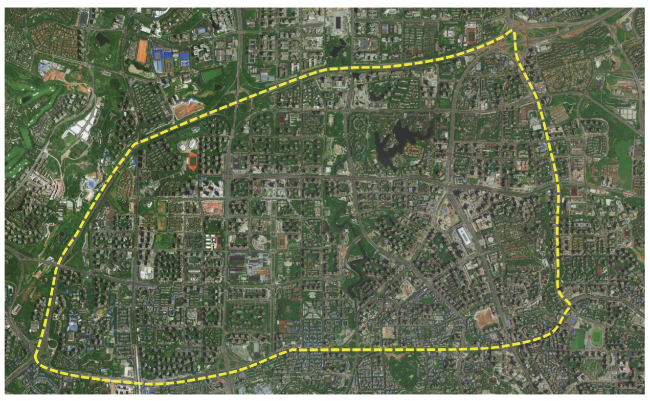
为验证所提方法的可行性和有效性,经综合比选,选取重庆市中心城区内环线以内西北方向的一个片区作为研究案例。该片区东西最宽约为6.5 km,南北最宽约为4 km,具体如图1所示(图中虚线包围区域,包含边界道路)。案例区域内用地类型多样,包含大型商务区、市级政府机构、大型商业综合体、住宅连片区、大型综合医院、大型酒店、公交枢纽站、长途汽车站以及中小学校等;片区交通流量大,交通设施种类丰富,涉及4条地铁线路12个地铁站,具有很强的城市交通代表性。研究所采用的出租车轨迹数据为重庆市中心城区2019年5月份一个完整周的数据,轨迹数据的字段包含车辆编号、时间、经度、纬度、速度、载客状态(载客/空车)等。
3.2 上下客需求时空分布
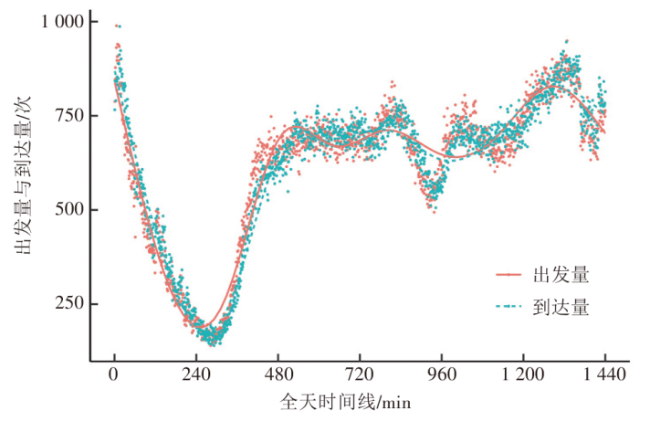
站点布局主要涉及站点数量和位置的确定两大核心问题。本研究在确定这两大要素时,以出租车上客需求时空分布为基准。基于3.1节所述出租车轨迹数据提取一周的出租车出行OD点,日期为2019年5月20日—26日,按分钟统计其出发和到达量,分布如图2所示。
由图2可以看出,在时间变化趋势上,出租车出行出发量和到达量比较接近。夜间20:00—0:00、白天13:00—14:00为出租车出行高峰,凌晨4:00—5:00为一天的出租车出行最低谷。交通基础设施布局通常以满足最大化需求为原则,因此,停靠站点的服务能力应以出租车出行高峰的需求为基准。
3.3 HDBSCAN空间聚类结果
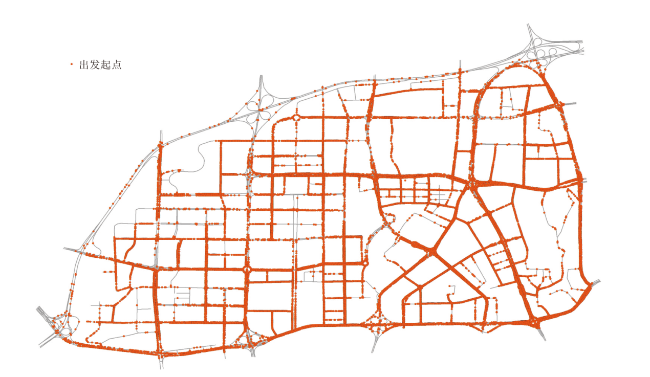
在站点布局上,通常以尽可能少的站点数量满足尽可能广的需求为原则,不能一味地以高覆盖率为目标,如果站点设置在需求较少的位置将造成资源浪费。本文在确定出租车停靠站点数量和位置时以需求密度为基准,在出租车高需求密度区域中心点设站点,对于低需求密度区域做到尽可能覆盖但乘客到达站点的步行距离可能相对长于高密度区域。
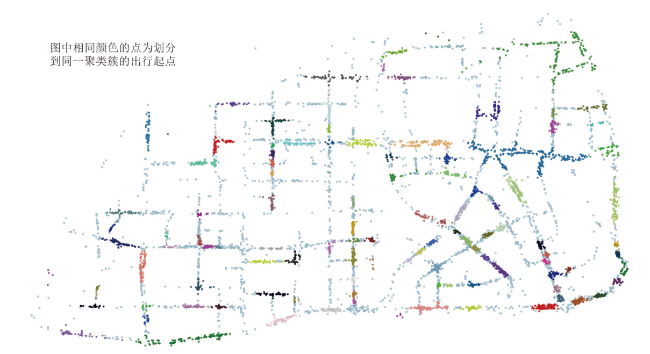
对研究区域的出租车出行起点进行HDBSCAN聚类,得到110个聚类簇,如图4所示。出租车出行需求密度在图中得到了较好的体现,高、低需求密度区域具有明显差异,部分稀疏点没有被分到任何一个聚类簇中。这种特征可以为出租车停靠站点建设提供较好的参考基准,即停靠站点在空间上并非需要均衡分布,高需求区域站点应更密,较低需求区域可不设站点。
3.4 布局备选点分布
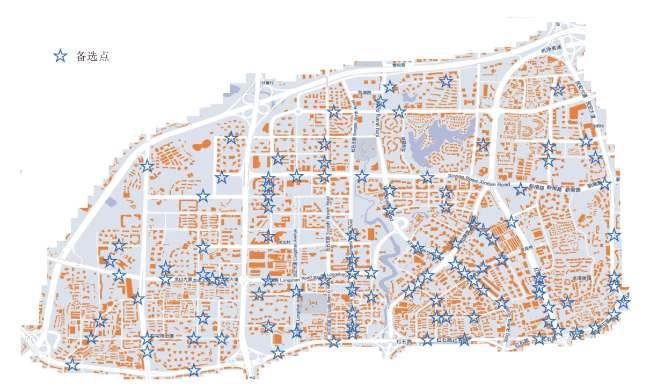
以上表明,备选点可较好地反映区域出租车出行密度,这不仅与本研究基于的出租车出行需求数据相一致,也与实地调研、居民认知相一致。
由于案例区域为城市建成区,出租车停靠站点的建设必然面临土地资源约束问题。对最终确定的备选点,其停靠站点建设的可行性、形式、规模应充分考虑其周边建成环境状况,以规划布局的落地为导向具体分析。本文随机选取了部分备选点进行实地踏勘,发现其通常邻近公交车站、商业综合体及路内停车位,这些位置一般具备增设出租车停靠站点的空间。将公交车站与出租车停靠站点合并设置是常见做法,有研究表明,通过合理设计,出租车停靠站点的增设一般不会干扰公交车辆的停靠及相邻车道的交通流[25]。
3.5 备选点覆盖率计算
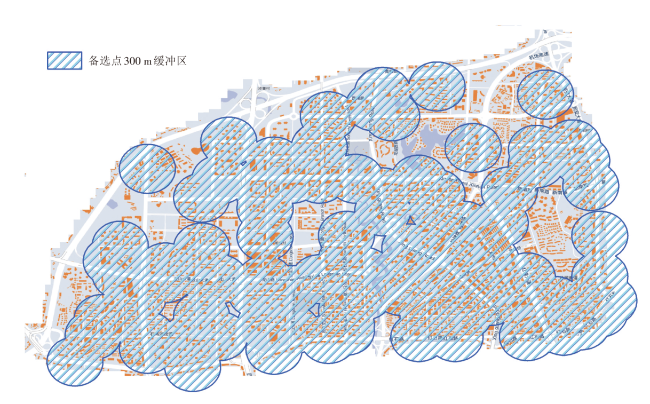
参考《城市综合交通体系规划标准》(GB/T 51328—2018)中对城市公共汽(电)车车站的服务区域覆盖率规定,其要求站点300 m的规划城市建设用地面积覆盖率不小于50%,500 m的覆盖率不小于90%。本研究对所有备选点建立300 m的缓冲区,缓冲区之间无重叠,计算得出案例区域布局的出租车停靠站点覆盖率约为76.0%,已远超过标准中公共汽(电)车站点300 m覆盖率要求,表明本研究得出的出租车停靠站点数量合理且站点覆盖水平较高。
出租车停靠站点覆盖范围如图6所示,图中建筑物密集区、主要道路都被覆盖,未覆盖区域主要为水体、公园绿地、低密度住宅区、未开发或尚在建设施工的区域。站点的泊位数或服务能力可依据HDBSCAN聚类簇大小确定。
4 结束语
本文采用出租车出行起点空间密度聚类的方法对城市出租车停靠站点的数量和备选点位置确定进行了研究。结果表明,引入HDBSCAN算法的出租车停靠站点布局在空间分布上与其出行密度相匹配,同时覆盖率优于规范要求。因而,在交通规划中引入机器学习方法可达到预期水平,并在效率上可能更有优势。在出租车停靠站点建设过程中,还应综合考虑备选点周边建成环境以确定规划建设停靠站点的可行性及站点容量。如规划的路内停靠站点若位于城市中心区,则可能在用地需求上存在难点,此时可在交通运行允许的条件下考虑与公交站点并站设置。本研究的重点在于出租车停靠站点的空间布局,未计算各备选点的停靠规模,未进行停靠站点的具体功能设计;受限于数据获取,空间聚类时未融入网约车出行起点数据。在未来研究中,首先可依据备选点的上下客强度计算停靠站点容量,亦可将网约车出行数据加入进行合并计算。其次,从推进城市综合交通体系建设的角度,今后在出租车停靠站点功能上可尝试“多站合一”设计,如增设电动汽车充电、多模式出行换乘等功能,以节约用地并提升站点吸引力。


