
0 引言
近年来,我国对节能减排和可持续发展越来越重视,不断出台新的政策方针来支持和引导绿色低碳经济的发展。2017年10月18日,习近平总书记在十九大报告中指出:“坚持人与自然和谐共生,必须树立和践行绿水青山就是金山银山的理念,坚持节约资源和保护环境的基本国策”。2020年9月,我国提出“二氧化碳排放力争于2030年前达到峰值,努力争取2060年前实现碳中和”的目标和愿景,这是党中央经过深思熟虑作出的重大战略决策,意味着我国将更加坚定地贯彻新发展理念,构建新发展格局,推进产业转型和升级,走绿色、低碳、循环的发展路径,实现高质量发展。2021年,中共中央、国务院印发《国家综合立体交通网规划纲要》[1],明确提出加快推进绿色低碳发展,交通领域二氧化碳排放尽早达峰,降低污染物及温室气体排放强度,并实现2035年交通绿色化水平居世界前列。交通领域作为第三大碳排放源,理应成为我国双碳战略的重要发力点。
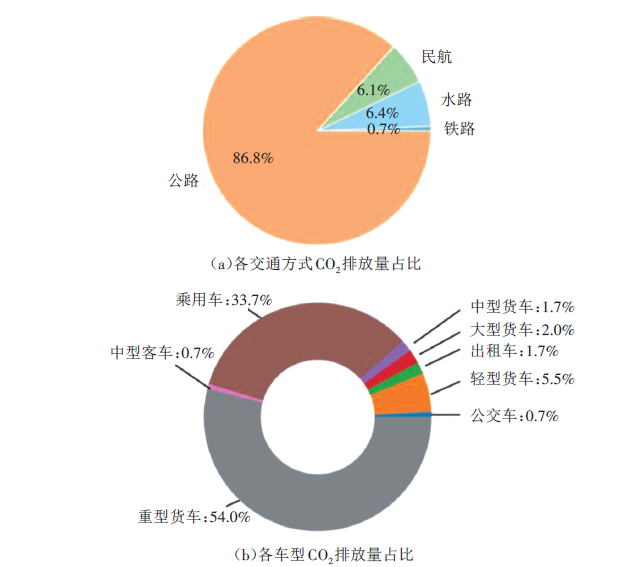
2018年,欧盟交通领域CO2排放量约为9.41亿t,占欧盟温室气体总排放量的27.34%[2]。2019年,美国交通领域CO2排放量约为18.43亿t,占美国温室气体总排放量的34.95%,是美国温室气体排放量的最大贡献者[3]。汽车运行阶段的CO2排放是欧美国家交通领域最主要的CO2排放来源。2019年,我国交通领域CO2排放量约为9亿~11亿t,占全国温室气体排放量的9%~10%[4-5]。与欧盟、美国等发达国家相比,中国的交通碳排放量较低。我国交通运输领域各交通方式的CO2排放量占比情况如图1所示[6],其中公路运输占比最大。由此可见,公路运输是整个交通运输行业节能减排的关键,具有巨大的碳减排潜力。
针对交通运输领域的碳排放问题,国内外学者开展了大量研究。在模型上,使用LEAP(Long -range Energy Alternatives Planning System)[7], NET-Transport(National Energy Technology-Transport), C3IAM/NET-Transport, TMOTEC, TREMOVE[8], ASTRA[9]和其他计量学经济模型的居多。Fan等人[10]使用LEAP模型,结合鼓励公共交通、推广新能源和清洁能源汽车、缓解交通拥堵等常规措施对北京客运交通进行碳减排分析;Li等人[11]开发了NET-Transport模型,结合使用清洁燃料汽车、提高汽车燃油效率的措施对中国客运交通CO2排放量进行预测,认为2030年左右将达到排放峰值;Tang等人[12]采用C3IAM/NET-Transport模型,结合优化交通结构、提高能源效率、推广替代燃料等对策对中国城际客运CO2排放量进行了预测,明确了我国城际客运车辆技术和燃料的可持续发展路径;萨和雅等人[13]运用STIRPAT模型对内蒙古自治区碳排放进行了预测研究;Logan等人[14]采用OPEM模型和TEAM-UK模型,从运营排放和全生命周期两个角度对英国在2050年是否可以达到净零减排的目标进行分析,结果显示英国必须采取严格的减排措施才有可能达到这一目标。邹才能等人[15]按照未来车辆保有量高速、中速、低速发展3种情景预测2060年中国碳排放量将分别降至22亿t, 33亿t和44亿t,并针对中国实现碳中和提出7项建议,提出构建中国新的“三小一大”能源结构,推动实现中国能源的独立自主。胡大伟等人[16]考虑速度和负载对能源消耗和CO2排放的影响,基于燃油车和电动车的行驶与排放特性,分别建立了燃油车和电动车的两阶段开放式选址路径问题模型,结果表明,与燃油车相比,电动车能节约3.44%的总成本、减少74.03%的CO2排放量。在方法上,学者们主要采用回归分析法、时间序列法、情景分析法、系统动力学方法、投入产出法和智能算法等,例如:高妍南等人[17]以哈尔滨为例,运用系统动力学方法构建城市低碳交通系统模型,并对城市交通碳排放进行分析。
综上所述,关于交通领域碳排放未来预测和达峰年份的研究以情景分析为主,重点关注2030年、2040年、2050年中长期时间节点的碳排放情况,研究对象涉及道路交通、水路交通、铁路交通等。本文以道路交通中的传统燃油车和纯电动汽车为研究对象,采用OPEM模型,运用行驶里程法,在未来车辆保有量低速发展和高速发展两种模式下,分别设定相应的禁售燃油车情景,并将问题的研究分为两个阶段:第一阶段主要研究2020—2050年纯电动汽车相较于传统燃油车的碳减排程度以及探究禁售燃油车年份区间;第二阶段是在第一阶段的基础上,从获取的禁售燃油车年份区间中找出最优禁售燃油车年份。根据研究结果,得出不同年份禁售燃油车的碳减排程度,以期为禁售燃油车政策的分步实施提供理论依据,并为制定符合中国国情的碳达峰碳中和实施路线提供参考。
1 方法、模型和数据
1.1 研究方法
中国政府尝试通过鼓励以纯电动汽车取代燃油车从而减少CO2排放。一方面,纯电动汽车在运营阶段实现了零排放,但在能源消耗阶段仍有碳排放。与燃油车相比,纯电动汽车减排程度还有待进一步论证。另一方面,世界主要国家禁售燃油车政策规划的出台也加速了中国政府在规划燃油车禁售政策上的步伐。然而,中国是世界上人口最多的国家,目前经济正处在高速发展阶段,若采取一刀切的禁售燃油车政策将给产业结构调整带来巨大挑战。因此,对于何时禁售燃油车、禁售燃油车政策的分步实施仍需要进一步研讨。本文将该问题的研究分以下两个阶段进行。
第一阶段,主要研究纯电动汽车相较于传统燃油车的碳减排程度以及探究禁售燃油车年份区间。由于车辆保有量对于碳排放的影响很大,且未来车辆保有量发展快慢受多种因素影响,因此,本文考虑了未来车辆保有量低速发展和高速发展两种模式,共设定12种禁售燃油车情景,如图2所示。其中,情景(2),(4),(6),(8),(10),(12)设定的是市场上燃油车占比为100%,即没有纯电动车,这是为探究纯电动汽车的减排程度而设置的参照情景;情景(1),(3),(5),(7),(9),(11)是随机选择2030年、2035年、2040年作为年份区间的分段点,把2020—2050年年份区间划分成2020—2030年、2031—2035年、2036—2040年、2040—2050年等4个年份区间,以探究最优禁售燃油车的年份区间,通过在不同的禁售年份设置不同的纯电动汽车渗透率来体现。这样设置是因为直接研究2020—2050年时间跨度太大,会影响计算结果的准确性,而按年份区间划分可以直接筛选掉不满足道路交通碳达峰要求的禁售时间段,并且计算结果准确性更高。
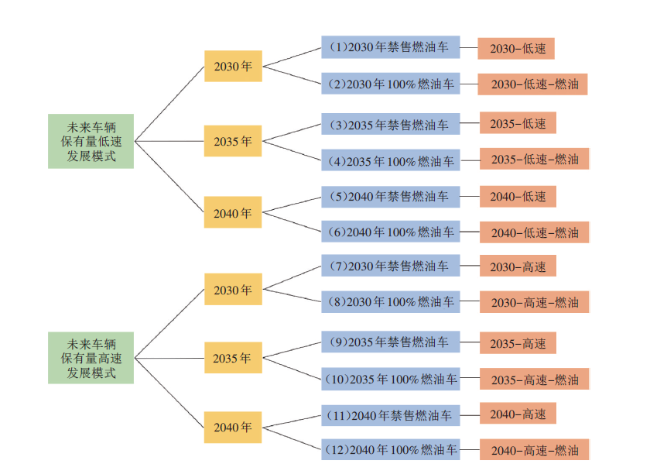
第二阶段是在第一阶段的研究基础上,从获取的禁售燃油车年份区间中选出最优禁售燃油车年份。在车辆保有量低速发展和高速发展的模式下,将第一阶段得到的禁售燃油车年份区间里(2020—2030年、2031—2035年、2036—2040年、2041—2050年这4个年份区间的某一个)的每一年份进一步设定成不同禁售燃油车情景,其中每一禁售年份通过设定不同的纯电动汽车市场渗透率来体现差异,以探究满足道路交通2030年碳达峰目标下最佳的禁售燃油车年份。
基于国际能源署、国家统计局、中国汽车工业协会和交通运输部对车辆类型、行驶距离等数据的统计,使用OPEM模型模拟2020—2050年传统燃油车和纯电动车在中国的交通碳排放。
1.2 研究模型
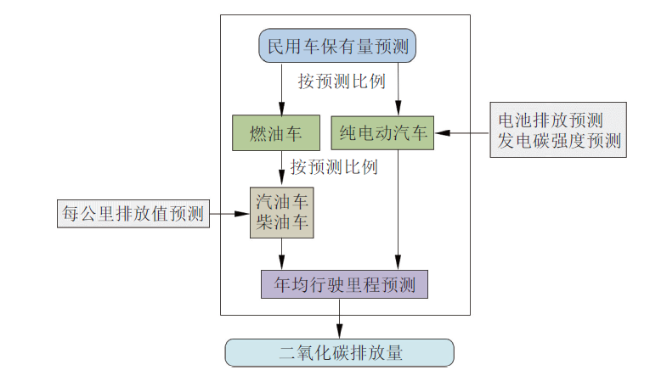
OPEM(Operation Emission Model)[14]是由英国能源研究中心开发的用于计算电动汽车和化石燃料汽车在道路上混合运行阶段CO2排放的模型,其基于行驶距离、燃料使用和发电排放等因素,可以测算车辆每年运行过程中的CO2排放量。该模型不包括基础设施建设以及车辆生产和报废处理产生的排放,且研究对象只考虑燃油车和纯电动汽车,未考虑混合动力汽车。该模型对数据量要求不高,可以在数据不完备的情况下实现有效的碳排放预测。本文考虑中国国情,在默认我国发电结构更清洁、内燃机减排技术提升以及公共出行比例有所提高的情况下,以未来车辆保有量低速和高速两种增长模式为背景,设定情景假设,运用OPEM模型,预测到2050年道路车辆在运行阶段的CO2排放量。计算思路如图3所示。
1.2.1 纯电动汽车碳排放预测模型
使用公式(1)[14]估算100%纯电动汽车产生的CO2排放水平。
式(1)中:EVs为纯电动汽车碳排放量(g),该值由车辆使用过程中充电碳排放和电动汽车电池碳排放两部分组成;D为每辆车年均行驶距离(km),参考我国生态环境部发布的《中国移动源环境管理年报(2021年)》[18],D取13000~15000km;Vbev为当年估计的纯电动车保有量(辆);E为能源效率(g/(kW·h)),我国《新能源汽车产业发展规划(2021—2035年)》[19]提出,到2025年,纯电动乘用车新车平均电耗降至12.0kW·h/100km,因此E取0.12kW·h/km;F为能源生产低效的校正因子,为了解释低效、配电和网络损失,F取1.11[20];B为电动汽车电池单位距离排放量(g/km),B的初始值取53.34g/km[21];CI为发电碳强度(g/(kW·h)),参考《中国汽车低碳行动计划研究报告(2021)》[21],以2020年的557.03g/(kW·h)为初始值,设2020—2030年每年减少21.4g/(kW·h),2030—2050年以每年减少11g/(kW·h)。
当年的纯电动车保有量Vbev按式(2)进行估算:
式(2)中:Vall为当年车辆总保有量(辆);MP为纯电动汽车市场渗透率(%),1.2.2节将具体给出。
1.2.2 燃油车碳排放预测模型
燃油车的碳排放水平使用式(3)估算[14],该方法考虑了汽油车与柴油车的占比不同。
式(3)中:CFVs为燃油车碳排放量(g),该值由柴油车碳排放量和汽油车碳排放量两部分组成;Ddiesel为柴油车年均行驶距离(km);Vdiesel为当年的柴油车估计数量(辆);Kdiesel为柴油车每公里行驶的CO2排放估计值(g/km),该值随着汽车技术的改进而调整,本文参考文献[19],设置柴油车每公里的排放值从207.0g/km降到197.0g/km;Kgasoline为汽油车每公里行驶的CO2排放估计值(g/km),本文参考文献[19],设置汽油车每公里的排放值从153.3g/km降到144.0g/km;Dgasoline为汽油车年均行驶距离(km);Vgasoline为当年的汽油车估计数量(辆)。
当年的柴油车数量Vdiesel和汽油车数量Vgasoline分别按式(4)、式(5)估算:
式(4)~式(5)中:m为纯电动车在新能源车中的占比(%);n为柴油车在燃油车中的占比(%); 表示当年新能源车数量。
汽油车与柴油车年均行驶里程、柴油车在燃油车中的占比、纯电动车在新能源车中的占比参考我国生态环境部发布的《中国移动源环境管理年报(2021年)》[18],将Ddiesel和Dgasoline的值设为13000~15000km,n取8%,m取80%
1.3 数据采集
1.3.1 车辆保有量数据
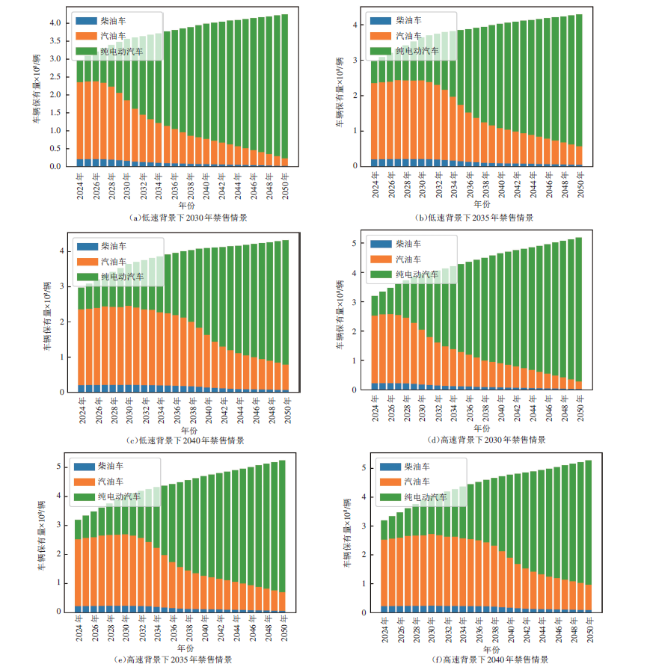
1.3.2 不同情景下纯电动汽车市场渗透率
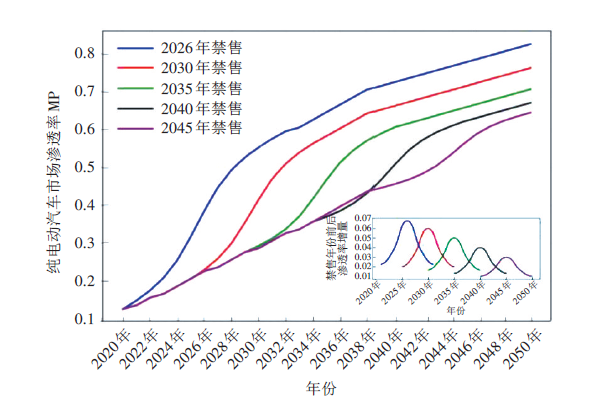
纯电动汽车市场渗透率MP是用来计算不同禁售情景下纯电动汽车数量的中间参数,纯电动汽车市场渗透率与当年车辆保有量的乘积即为当年纯电动汽车的数量。随着燃油车禁售年份的接近,消费者将开始倾向购买纯电动汽车,纯电动汽车的市场占比逐渐增加,即纯电动汽车市场渗透率变大。因此,本文作出如下假设:在相应年份的禁售点前后5年,纯电动汽车的渗透率明显上升。参考文献[14]中,纯电动汽车的渗透率是由嵌在OPEM模型内部的运输需求模型和车辆库存模型综合计算得出的结果,其中,根据每年的运输需求来更新每年的车辆库存,而新车的价格反过来又影响下一年的运输需求。本文对其数据进行分析,发现纯电动汽车渗透率MP在禁售年份前后5年服从正态分布,且随着禁售年份增长,峰值点逐渐变小。对文献[14]中的MP进行计算,发现其增量也呈正态分布。本文按照其正态分布规律,基于既有数据,参考英国的MP变化趋势,采用线性插值的方法,确定出2026年、2030年、2035年、2040年和2045年的MP增量峰值点分别为0.068, 0.06, 0.05, 0.04, 0.03,结合《新能源汽车产业发展规划(2021—2035年)》[19]中提出的到2025年新能源汽车新车销售量达到汽车新车销售总量的20%左右,2030年纯电动汽车成为主流这一目标,确定中国纯电动汽车市场渗透率在不同禁售年份的比例,如图5所示。
2 结果分析
2.1 第一阶段结果分析
2.1.1 纯电动汽车相较于传统燃油车的碳减排程度
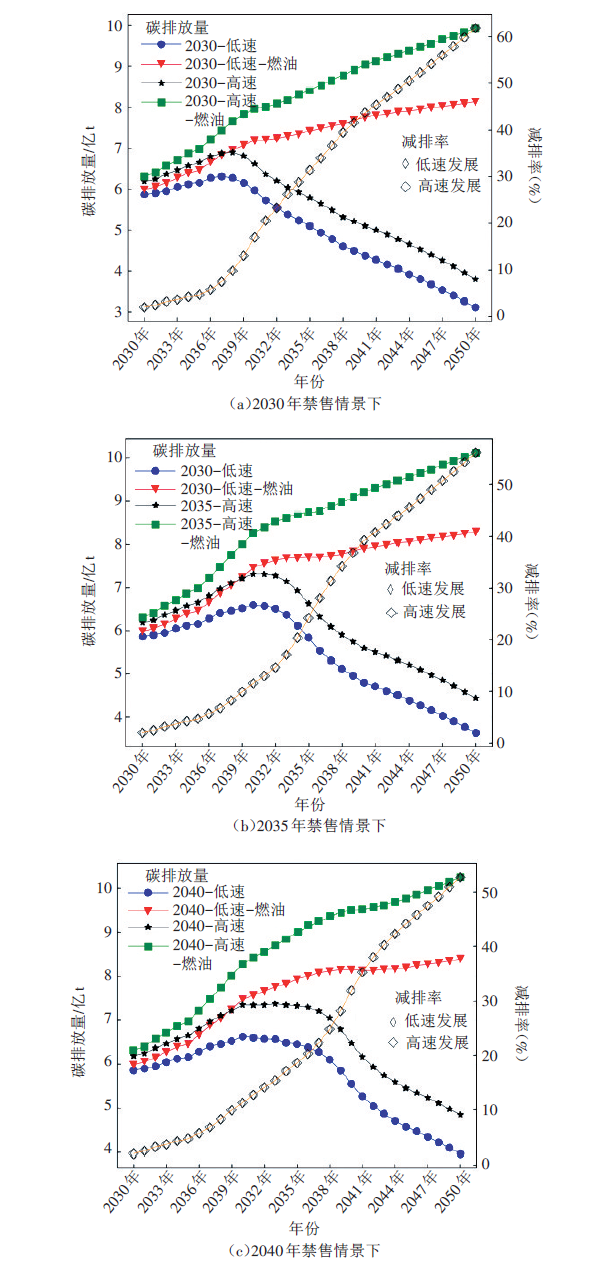
从图7可以看出,在设置的3种禁售年份下,碳排放量整体变化趋势较为相似。其中,传统燃油车碳排放量逐渐增大,高速及低速背景下的碳排放量差异也逐渐增大。3种禁售燃油车情景下的碳排放量呈现先增大后减小的趋势,且高速及低速背景下碳排放量差异量的变化不大,较为均匀。减排率整体较为相似,随着年份推移而逐渐增大,且有进一步增大的趋势。在纵向比较中,未来车辆保有量无论低速发展还是高速发展,减排率曲线基本重合。
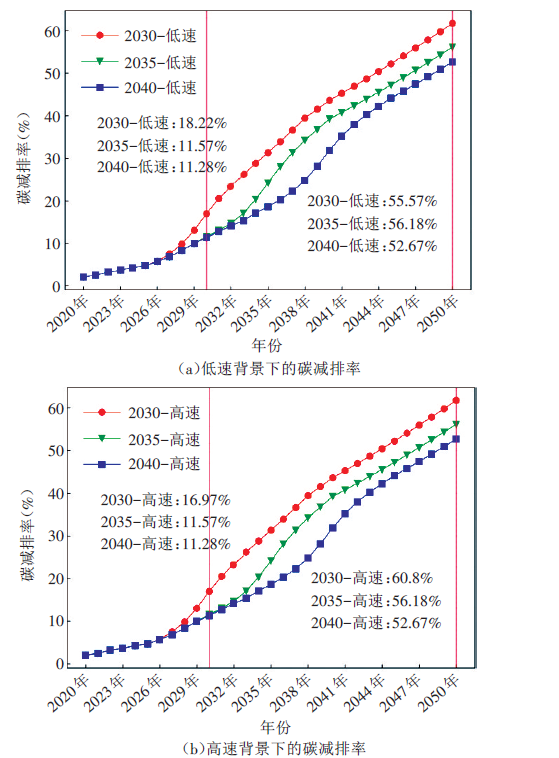
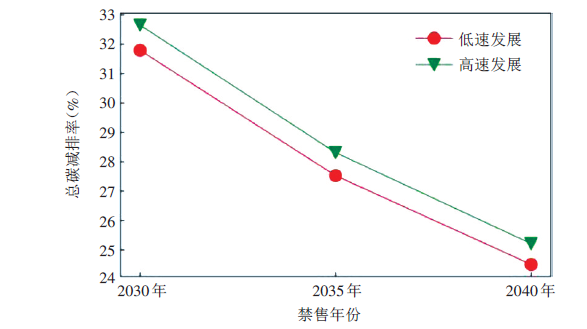
图9为2030年、2035年、2040年3种禁售燃油车年份下2020—2050年累计碳减排程度比较。可以看出:2030年禁售燃油车,低速背景下将减排31.79%,高速背景下将减排32.65%;2035年禁售燃油车,低速背景下将减排27.53%,高速背景下将减排28.31%;2040年禁售燃油车,低速背景下将减排24.51%,高速背景下将减排25.21%。综合来看,未来车辆保有量高速发展背景下,累计碳减排程度始终高于车辆保有量低速发展下的情况。
2.1.2 禁售燃油车年份区间分析
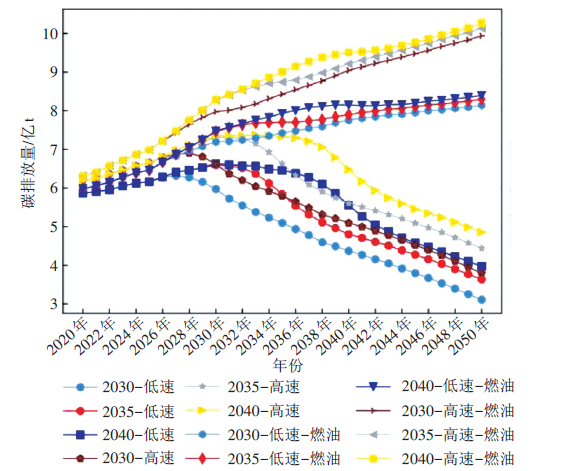
经过OPEM模型计算,12种情景下碳排放量如图10所示。可以看出,在2020—2050年区间内,6种100%燃油车情景在低速和高速发展模式下都未出现峰值点,且高速发展模式下的碳排放量始终高于低速发展模式下的碳排放量。其原因是,在高速发展模式下,车辆数量增加速度快,使得同一时期内车辆保有量大,碳排放量增多。在其他6种情景下,碳排放量在2020—2050年区间内均出现了峰值点。其中,2030年禁售燃油车情景下,在低速发展模式和高速发展模式下2026—2030年为峰值平台期,分别在2027年和2028年出现峰值点;2035年禁售燃油车情景下,在低速发展模式和高速发展模式下峰值年份均为2030年;2040年禁售燃油车情景下,低速发展模式下峰值年份为2030年,而高速发展模式下峰值年份为2033年。总体碳排放的峰值为5.97亿~7.37亿t,考虑到道路交通碳排放与国家2030年前碳达峰的战略目标同步,在2030年、2035年、2040年禁售情景中,只有2030年禁售情景可以达到目标要求,2035年及以后禁售燃油车均未在2030年前出现峰值。为此,将禁售燃油车年份区间设定为2026—2034年。
2.2 第二阶段结果分析
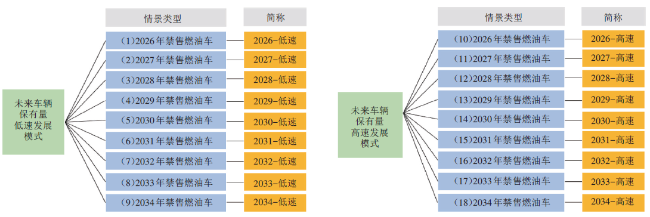
从第一阶段获取的禁售燃油车年份区间中研究选出最优禁售燃油车年份。本文第一阶段研究得到的最优禁售区间为2035年之前,2035年及以后禁售都未能在2030年出现峰值点。因此,第二阶段是在车辆保有量低速和高速发展的背景下,将2026—2034年区间内的每个年份设定成18种禁售燃油车情景,如图11所示。
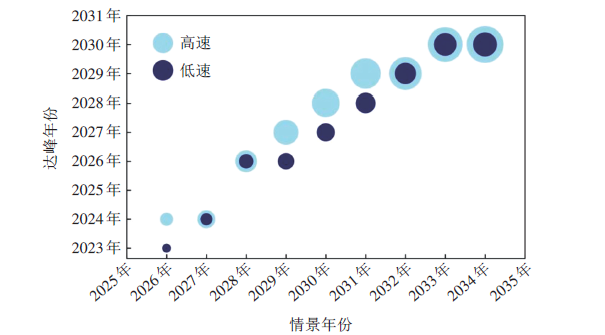
用OPEM模型计算出的2020—2050年碳排放量如图12所示。可以看出,2026—2034年间各年份禁售燃油车情景在2020—2050年区间碳排放量均出现峰值,峰值年份区间为2023—2030年,峰值为5.91亿~7.31亿t,比第一阶段2030年、2035年、2040年这3个禁售年份情景的碳排放量低。对于同一禁售燃油车年份,即纵向比较来看,除2027年、2028年、2032年、2033年、2034年这5个禁售年份外,高速发展模式下峰值年份要比低速发展模式下峰值年份滞后1年。从横向比较来看,除2027年与2028年外,其他相邻年份的峰值年份无论在高速发展模式下还是在低速发展模式下相差都不超过1年。
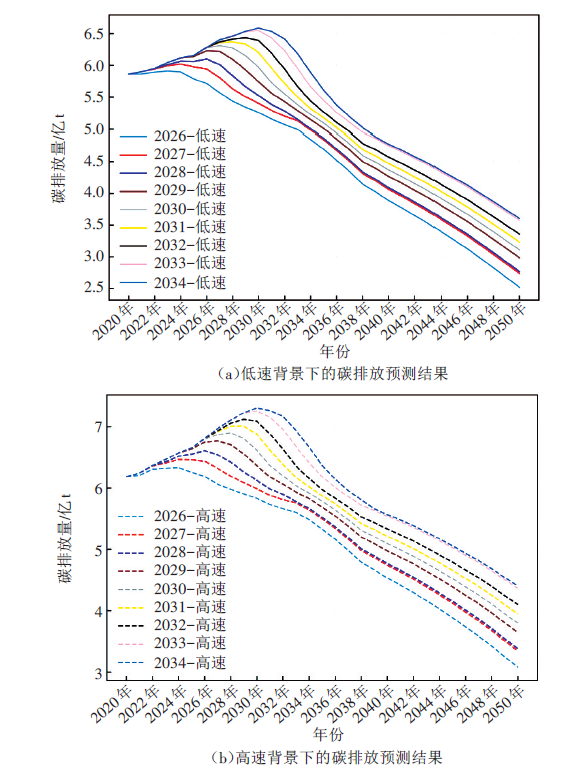
图13是2026—2034年各禁售燃油车情景下的峰值情况,实心圆的大小表示相应峰值年份的碳排放量,实心圆半径越大,表明碳排放量越高。可以看出,2033年和2034年禁售燃油车情景下的峰值年份均为2030年之后,未能与国家碳达峰目标同步。综合考虑经济因素以及国家碳达峰战略目标,禁售燃油车年份应不晚于2032年。
本文引入不同禁售年份下的纯电动汽车渗透率MP,设置的多种禁售年份情景包含了文献[23]设置的强化措施和常规措施情景。文献[23]在高增长强化措施情景下得到的碳排放峰值年份与本研究中未来车辆保有量高速发展背景下2029年禁售燃油车情景得出的峰值年份都为2027年;高增长常规措施情景下峰值年份与本研究中未来车辆保有量高速发展背景下2031年和2032年禁售燃油车情景得出的峰值年份都为2029年;低增长强化措施情景下得出的峰值年份与本研究中未来车辆保有量低速发展背景下2030年禁售燃油车情景得出的峰值年份都为2027年;低增长常规措施情景下得出的峰值年份与本研究中未来车辆保有量低速发展背景下2032年禁售燃油车情景得出的峰值年份都为2029年。峰值点在禁售年份之前就出现的原因是:政策的发布往往会短期刺激人们消费,本文假设在禁售年份前后5年,纯电动车的渗透率明显增加。此外,本文设定的其他情景得到了文献[23]未获得的结果:2026—2034年间每一年禁售燃油车的峰值年份与峰值点。文献[23]的研究达峰值与本文有差异的原因是采用的车辆保有量数据不同,而车辆保有量数据会显著影响碳排放量。
3 讨论
《中共中央 国务院关于深入打好污染防治攻坚战的意见》[24]中指出,“‘十四五’时期,我国生态文明建设进入了以降碳为重点的战略方向、推动减污降碳协同增效促进经济社会发展全面绿色转型、实现生态环境质量改善由量变到质变的关键时期”。
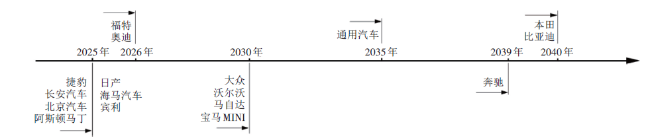


对于传统燃油车的禁售年份,本文研究得出的结果是:在没有其他碳减排举措下,应不晚于2032年。这比大多数发达国家的禁售燃油车时间要早,主要原因是中国是发展中国家,碳排放量尚未达峰,中国的战略目标是2030年前实现碳达峰,禁售燃油车时间早有利于碳达峰目标的实现。此外,与发达国家不同,中国是世界上人口最多的国家,目前仍正处在经济高速发展阶段,考虑到中国国情,若采取一刀切的禁售燃油车政策将对产业结构的调整带来巨大挑战。工信部发布的《对十三届全国人大二次会议第7936号建议的答复》[27]明确表示,将支持有条件的地方和区域开展城市公交出租先行替代、设立燃油汽车禁行区等试点,在取得成功的基础上,统筹研究制定燃油汽车退出时间表。此外,中国从2030年碳达峰到2060年碳中和只有30年时间,即碳达峰后需要快速走向碳中和。欧盟承诺的碳达峰至碳中和的时间为60~70年,缓冲时间是中国的2倍[15],美国承诺的碳达峰至碳中和时间为45年,是中国的1.5倍。因此,中国不能复制国外的碳中和模式,何时禁售燃油车、禁售燃油车政策的分步实施需要根据中国国情来进一步研究分析,制定符合中国国情的碳达峰碳中和实施路线。
4 结论
本文运用OPEM模型,结合相关政策和研究现状,采用行驶里程法,以燃油车和纯电动车为研究对象,以2020—2050年为研究年份,计算并分析纯电动汽车的碳减排程度以及最晚禁售燃油车年份。考虑到直接研究2020—2050年时间跨度太大,会影响计算结果的准确性,因此本文将该问题的研究分为两个阶段,逐渐缩小研究范围。第一阶段,在未来车辆保有量低速发展和高速发展两种模式下,随机选择2030年、2035年、2040年作为年份区间的分段点,设定12种燃油车禁售情景来研究2020—2050年纯电动汽车相较于传统燃油车的碳减排程度,初步得出禁售燃油车年份区间为2026—2034年;第二阶段,在未来车辆保有量低速发展和高速发展两种模式下,将第一阶段得出的禁售燃油车年份区间,按各年份重新设定禁售情景,研究不同年份禁售燃油车对于碳中和的影响和对应的峰值年份。通过两阶段研究,得出以下结论:
(1) 2030年、2035年、2040年禁售燃油车在很大程度上可以减少碳排放量,到2050年,减排率分别达到61.8%, 56.18%和52.67%。从累计碳减排程度来看,2030年禁售燃油车,车辆保有量低速发展背景下将减排31.79%,车辆保有量高速发展背景下将减排32.65%;2035年禁售燃油车,车辆保有量低速发展背景下将减排27.53%,车辆保有量高速发展背景下将减排28.31%;2040年禁售燃油车,车辆保有量低速发展背景下将减排24.51%,车辆保有量高速发展背景下将减排25.21%。
(2) 以2030年、2035年、2040年作为年份区间分段点,将2020—2050年划分成2020—2030年、2031—2035年、2036—2040年、2041—2050年等4个年份区间,在保证道路交通碳达峰目标与国家碳达峰目标同步的前提下,得出最优禁售燃油车的年份区间在2035年之前。
(3) 对最优禁售燃油车年份区间进一步分析,得出禁售燃油车的年份应不晚于2032年。且除2027年与2028年外,其他相邻年份无论在车辆保有量高速发展模式下还是低速发展模式下,峰值年份相差均不超过1年。
今后将从以下方面进一步开展研究:
(1)本研究未考虑混合动力汽车,未来的研究将从燃油车、纯电动汽车以及混合动力汽车3个角度来完善OPEM模型,这样将更符合现实情况;
(2)虽然OPEM模型可以根据数据预测结果,但随着中国碳达峰目标的实现,政策可能会发生改变,未来将就数据的动态变化对碳排放量的影响展开研究;
(3)未来将分领域(公交车、出租车、私家车等)、分区域(城市、乡村等)对交通碳排放展开研究并进行燃油车禁售政策分析;
(4)本研究基于现有的数据采用OPEM模型求得的预测值只是车辆的运营排放,若从道路运输综合碳排放量的角度看,还需要从全生命周期进行分析,即考虑车辆的生产制造、维修、报废以及基础设施建设等全生命周期的碳排放测算。