
0 引言
现有研究中,乘客候车时间计算方法主要分为两种。第一种是将乘客行程时间分解,利用刷卡数据计算乘客候车时间[5]。这种方法是将行程时间拆分成进出站时间、候车时间、换乘时间和乘车时间,在计算站点进出站时间后获得乘客的候车时间[6-7]。第二种方法是利用乘客到达时间和列车到达时间的差值计算等待时间。不过乘客不一定在第一班列车到达时就能上车,因此常通过数据驱动的方法进行判断[8⇓-10]。除了利用刷卡数据计算乘客候车时间,还有部分研究通过人工调查的方法研究乘客候车时间和位置分布[11-12],虽然此方法很难进行大范围调查,但有助于研究乘客在站台的候车分布。不同站点的平均候车时间通常不同,地铁站距离城市中心越远,平均候车时间越长[13]。地铁站站台层连接设施的通行能力也会影响乘客的候车时间[14]。候车时间过长会导致乘客产生不满情绪。已有研究结果表明,等待时间在5min内较为合理,且拥挤现象多在高峰时段出现[15⇓⇓-18]。
综上,现有研究多仅利用刷卡数据,通过不同站点之间的距离计算列车行驶时间,但由于不同线路车辆的运行时间是不同的,依靠距离计算行驶时间是不准确的,影响了地铁运营服务质量的评价精度。因此本文提出了利用自动售检票系统(Automatic Fare Collection, AFC)数据和列车时刻表数据,基于数据驱动和判别分析法计算乘客候车时间和滞留次数的方法,为地铁运营管理提供精准的数据支撑。
1 地铁乘客出行过程分解
乘客类型可按照是否换乘分为未换乘乘客和换乘乘客,由于二者出行过程不同,本研究分开讨论。本研究按照地铁站内设施功能及出行起点到终点(Origin to Destination, OD)将未换乘乘客出行过程分解成4个阶段,分别为进站阶段、候车阶段、列车行驶阶段、出站阶段,如图1 所示。
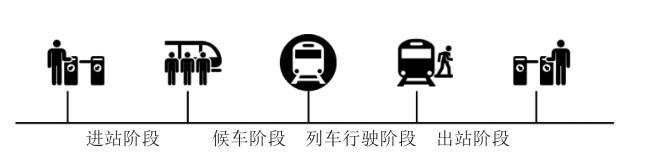
其中,进站阶段为乘客进站刷卡后步行至站台层的时间;候车阶段为乘客在站台层等待乘车的时间;列车行驶阶段为列车行驶至目的地的时间;出站阶段为乘客下车直至刷卡出站的时间。值得注意的是,尽管对于乘客而言进站时间包括自地铁站口步行至闸机刷卡的时间,但由于该阶段的时间对乘客在站台层候车时间的计算无影响,因此本文不做研究,出站时间同理。
对于换乘乘客而言,相比未换乘乘客增加了换乘阶段,即通勤时间增加了第1次乘车和第2次乘车之间的换乘时间。为便于展示,仅展示一次换乘乘客出行过程,如图2 所示。
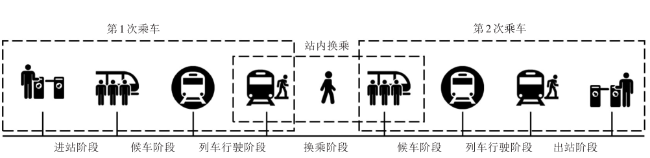
二次换乘乘客在第2次乘车的列车行驶阶段和出站阶段之间再增加换乘阶段—候车阶段—列车停靠阶段—列车行驶阶段,多次换乘同理。
2 站台候车乘客识别及特征计算方法
2.1 行程时间计算方法
根据地铁AFC数据可提取乘客的出行时间 ,即:
式(1)中: 为乘客下车刷卡时刻; 为乘客上车刷卡时刻。
对于未换乘的乘客,出行时间 由进站时间 ,候车时间 ,列车行驶时间 和出站时间 组成,即:
对于多次换乘的乘客,出行时间 的组成如下:
式(3)中: 为乘客第 次乘车的候车时间; 为乘客第 次乘车的列车行驶时间; 为乘客第 次换乘的换乘时间; 为乘客的乘车次数; 为乘客的换乘次数, 。
2.2 标记乘客识别方法
式(2)中,列车行驶时间 可由列车时刻表数据获得,因此为计算乘客的候车时间 ,还需要计算乘客的进站时间 和出站时间 。考虑到实际过程中可能存在候车时间 =0的情况,即乘客到了站台层后车辆已经停在了站台而无需等车,对于这类乘客即为标记乘客。无换乘标记乘客的行程时间计算方法为:
同理,多次换乘标记乘客的行程时间计算方法为:
对于同一个OD,出行时间 最短的乘客即为该OD的标记乘客。
2.3 地铁站进出站时间和换乘时间的计算方法
对于乘客的一次出行而言,进站和出站是不同的两个地铁站。每个地铁站的规模和内部构造不尽相同,因此乘客的进站时间和出站时间不同。但对于同一地铁站,乘客进站步行距离和出站步行距离基本相同,因此可以假设同一站点的乘客的进站时间 和出站时间 是相同的。
基于上述假设,就可以用不同OD的标记乘客的行程时间差值计算不同站点的进站时间 和出站时间 ,具体方法如下:
首先,选择同一条线路起点相同终点不同的两名未换乘标记乘客1和乘客2。设起点为A站,终点分别为B站和C站,乘客1和乘客2的行程时间分别为:
式(6)中: 为乘客1的行程时间; 为A站的进站时间; 为A站和B站间列车行驶时间; 为B站的出站时间。
然后,再选择一名起终点分别为B站和C站的未换乘标记乘客3,其行程时间为:
对于相同站点,可以认为不同乘客的进出站时间是相同的,即:
进而,可推导出A站、B站、C站的进出站时间为:
其中,列车行驶时间可以从列车时刻表数据获得。重复上述步骤,即可获得所有地铁站的进出站时间。
对于换乘乘客,还需利用一次换乘的标记乘客计算换乘站的换乘时间,选择标记乘客4,于站点A站上车,于D站换乘,到达E站,则D站的换乘时间 为:
同理,可以计算出所有换乘站的换乘时间。
2.4 站点滞留人数计算方法
基于2.1节至2.3节的计算结果,可以计算出每位乘客的实际候车时间。通过进站刷卡时间可以判断出乘客的等候时段 ,即可计算任意时刻的站点等候人数。
除此之外,利用列车到站间隔 和乘客等候时间 判断乘客是否滞留。滞留乘客是指乘客抵达站台层后未能在第一次列车抵达时上车而停留一次或一次以上的乘客。若 ,则乘客未滞留;若 ,则乘客滞留。若 且 ,则可以计算出乘客滞留了 次。对于一次或多次滞留的乘客,乘客的滞留时段为 。利用滞留时段,可以计算出任意时刻的站点滞留人数。
3 北京市地铁候车特征和滞留特征分析
3.1 数据选取及预处理
3.1.1 数据选取
本文选取2014年2月17日—21日5个工作日的北京市全部17条线路237个轨道交通站点的AFC数据和时刻表数据,对北京市地铁候车特征和滞留特征展开分析。选取工作日数据的主要原因是工作日比非工作日客流量大,全日大客流时段集中,候车特征和滞留特征更显著。该时段内地铁运行正常,无突发事件发生。
AFC数据记录了乘客的出行信息,主要包括上车站点、上车时刻、下车站点和下车时刻等关键字段。列车时刻表数据记录了列车的运营信息,主要包括列车的线路名称、站点名称、到站时间和方向等关键字段。但由于难免出现异常数据,因此需要对其进行清洗。
3.1.2 数据预处理
AFC数据的预处理工作主要从以下3个方面进行:
(1)清理缺失关键字段数据。由于缺失关键字段无法计算乘客的行程时间,因此需对该部分数据进行清理。如缺失数据为非关键字段,不影响乘客出行时间判断,则无需进行清理。
(2)清理非运营时间产生的数据。因AFC数据记录了所有刷卡进站的数据,包括非运营时段内车站保养及维修人员数据,所以需要根据线路运营时间筛选数据。
(3)清理行程时间过长或过短的数据。行程时间的计算方法在2.1节提出,可以根据列车运行时间、站间长度等数据确定最短行程时间和最长行程时间,清理过短或过长的行程时间。本文最短行程时间设置为站间列车运行时间,最长行程时间设置为4h,即北京市地铁乘客单次最长逗留时间。
列车时间表数据较AFC数据相对完整,但仍存在发车间隔跳跃的情况。对于该部分数据,利用邻近两班列车的发车间隔进行填充,补全缺失的运行数据。
3.2 北京市地铁候车特征分析
3.2.1 乘客候车时间分析
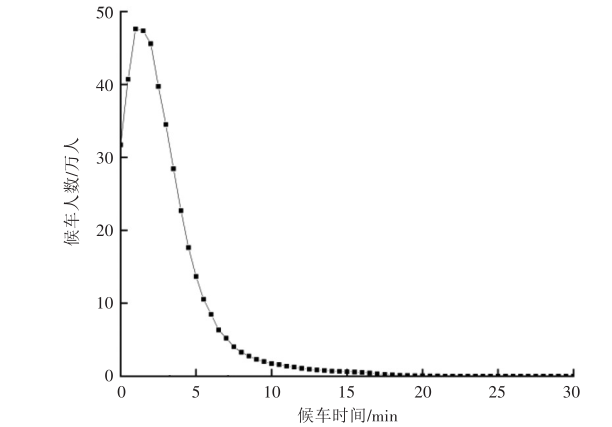
北京市地铁乘客的候车时间分布如图3 所示。候车时间整体呈现出正偏态分布,约90%的乘客可以在6.5min内上车,候车时间在3min内的乘客占比近60%,可以看出整体候车时间较短。
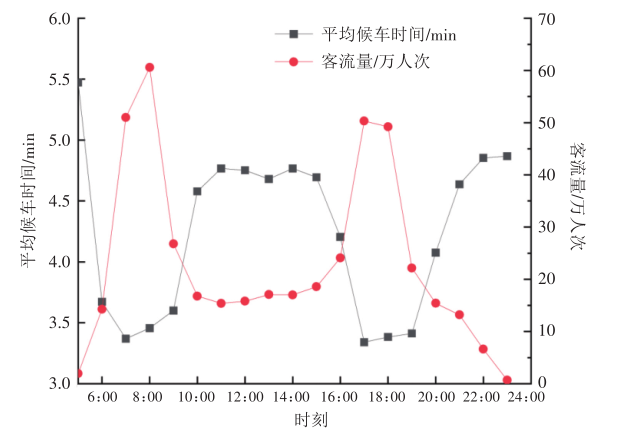
对北京市地铁乘客全日各时段平均候车时间及全网客流量进行统计,分布如图4 所示,平均候车时间整体呈“W”形,客流量整体呈“M”形。平均候车时间的低峰区段与客流量的高峰区段基本对应,平均候车时间的高峰区段与客流量的低峰区段基本对应,又因平均候车时间主要受发车间隔时间影响,所以高峰时段为疏解客流,提高了列车发车频率,使得乘客候车时间较短。
3.2.2 站点候车时间分析
计算北京市地铁站日均候车时间(见图5 )。可以看出北京市地铁站日均候车时间多集中在3~5min内,其分布整体呈现出由城市中心向郊区逐渐增加的趋势。
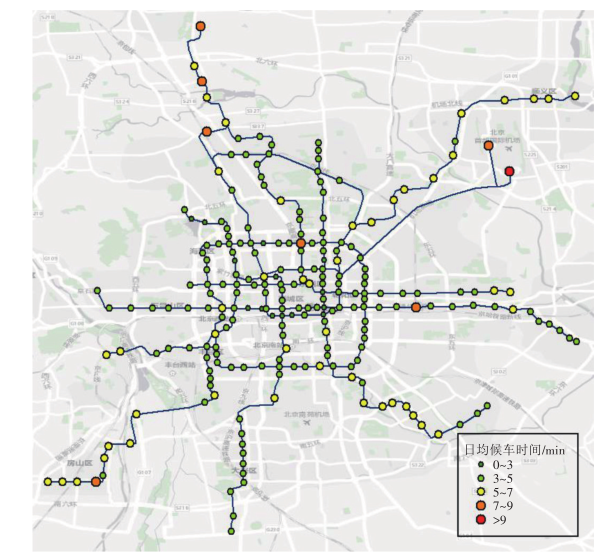
候车时间超过7min的站点主要集中在机场线和远郊区县的地铁线路及部分换乘站。候车时间较长的原因包括以下两方面:①由于线路自身到站间隔较长,导致乘客候车时间较长。机场线到站间隔约为10min,15号线平峰时段到站间隔约为8min,房山线平峰时段到站间隔约为8min,昌平线平峰时段到站间隔约为11min,亦庄线平峰时段到站间隔约为11min,这也导致这5条线路上部分站点候车时间超过了7min,远高于其他线路的到站间隔(3~5min)。②由于换乘站客流量较大,且两条线路到站间隔不匹配,导致换乘乘客候车时间较长,如四惠东站和北土城站。以四惠东站为例,其途经线路为1号线和八通线,1号线平峰时段到站间隔约为3min,八通线平峰时段到站间隔约为7min,乘客从1号线下车后需等候较长时间后才能上车。同时,由于四惠东站作为两条线路的首发站,部分乘客存在想要“等座”的心理,故意等下一班列车乘坐,导致日均候车时间较长。
3.3 北京市地铁滞留特征分析
3.3.1 乘客滞留特征分析
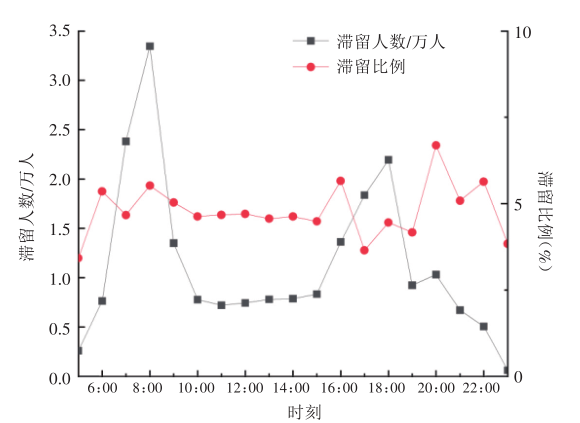
判断乘客是否滞留并计算各小时滞留人数和滞留比例,绘制全日各时段分布图(如图6 所示)。可以看出,滞留人数整体呈双峰形,这与图4 中客流量的分布曲线接近,可见滞留人数与客流量密切相关,客流量越大滞留人数越多。约45%的滞留乘客集中在早晚高峰(早高峰为7:00—9:00,晚高峰为17:00—19:00),这导致早晚高峰地铁站的管控压力较大。尽管平峰时段客流量较小,但仍有乘客滞留,其主要原因可能为乘客因等人或其他原因在站内逗留。尽管滞留人数整体呈现出全日不均衡性,但滞留比例全日各小时分布相对均衡,维持在5%的比例,表明列车到站间隔设置较为合理。
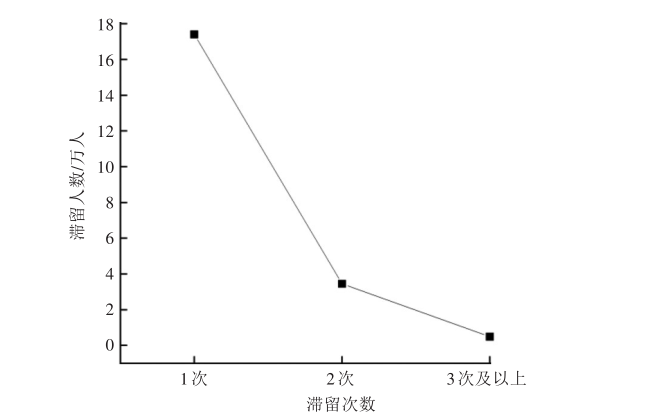
计算乘客的滞留次数,如图7 所示,可以看出滞留乘客中滞留1次的占比大,约占82%,滞留2次的乘客约占16%,滞留3次及以上的乘客仅占2%。
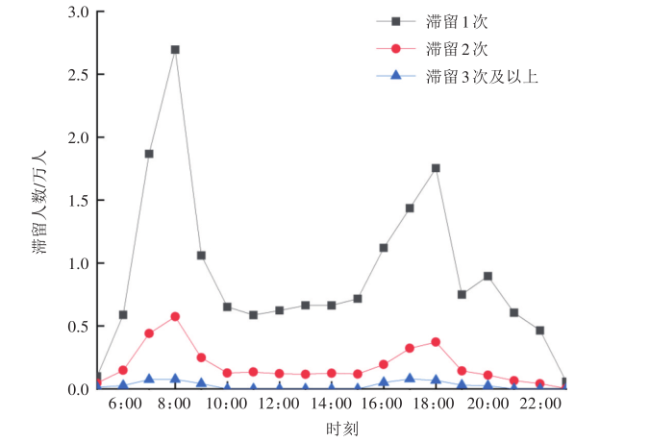
为进一步探究滞留次数的全日分布,绘制全日各时段滞留次数的小时分布图(如图8 所示)。可以看出,3种类型的滞留人数分布均呈双峰形。滞留次数越多,乘客的紧迫心理越强,对地铁站服务满意度就越低。滞留3次及以上的乘客几乎仅存在于早晚高峰,因此需着重注意地铁站在早晚高峰乘客的疏解能力,避免出现滞留多次的情况。
3.3.2 站点滞留人数分析
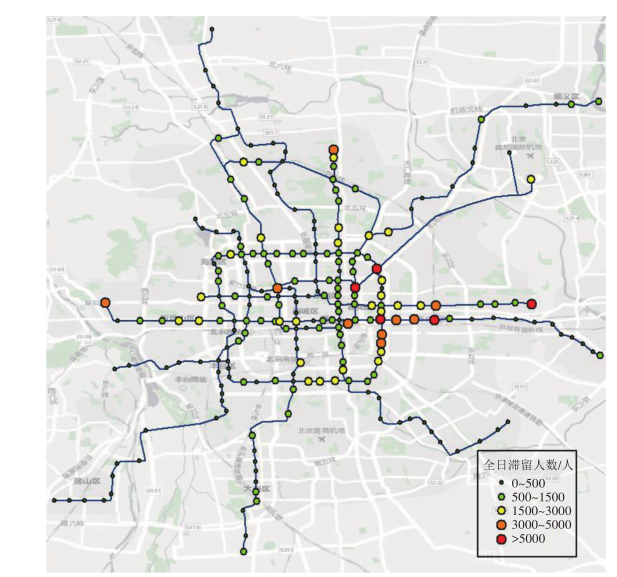
绘制北京市地铁站全日滞留人数分布(如图9 所示)。滞留人数较高的5个站点分别为三元桥站、东直门站、大望路站、四惠东站和草房站,均为换乘站或首末站。滞留人数较高的站点多分布在朝阳区,全日滞留人数超过3 000人的14个站点中,有9个站点坐落于朝阳区,主要分布在10号线、1号线和6号线上。
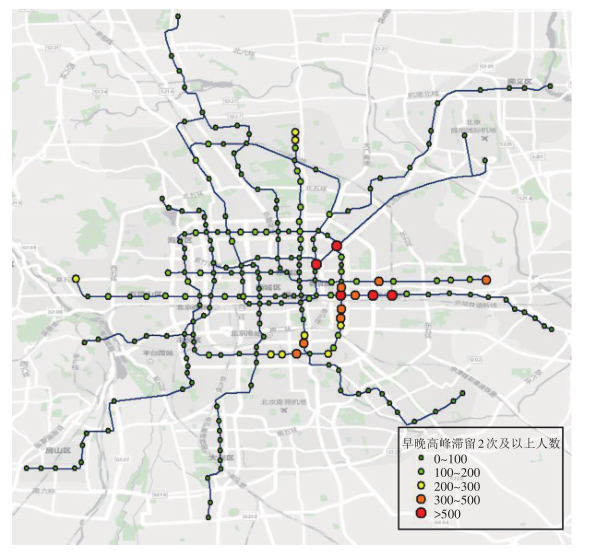
为进一步探究地铁站潜在满意度低的站点分布,绘制早晚高峰滞留2次及以上人数的分布图(如图10 所示)。可以看出早晚高峰滞留2次及以上人数较多的站点为三元桥站、东直门站、大望路站、四惠东站和四惠站,人数较多的站点主要分布在朝阳区,与全日滞留人数分布接近。


4 结语
本文利用AFC数据和列车时刻表数据构建了列车行程时间计算方法,通过数据驱动的方法,避免了采用距离测算列车行程时间的方式,较现有研究能够更精准地计算乘客乘坐地铁出行各阶段的时间。通过对比北京市所有轨道交通站点的平均候车时间和滞留次数,研究发现,滞留比例在全日小时分布较为均匀,约为5%,早晚高峰乘客候车时间较长,滞留次数较多;候车时间主要受列车发车时间和客流量的影响,候车时间较长的站点多位于地铁线路末端;滞留次数较多的站点多位于换乘站。因此,轨道运营管理人员应着重关注线路首末站及换乘站在早晚高峰对于乘客的疏解能力,避免发生因乘客拥挤引发安全事故。
由于多次滞留乘客滞留原因多样,仅依靠AFC数据和列车时刻表数据无法做到较为全面的分析,因此本文未分析多次滞留乘客的滞留原因,如朝阳区的换乘站点的多次滞留原因仍需从站内流线设计等角度进一步开展分析。同时,本文认为同一站点的进出站时间相同,尽管有很多学者也做出了同样的假设,但未考虑乘客之间的异质性,可进一步深入研究。