
0 引言
国内外关于高速公路服务区污水处理技术的研究已有很多。国际上,美国、日本、德国等发达国家大多采用小型、分散式污水处理工艺,目前主流处理技术为化粪池-土壤吸收系统、砂滤系统[8]、净化槽系统[9]、膜生物反应器和PKA湿地污水处理系统。经过多年研究与实践,一些发达国家高速公路服务区污水处理与回用技术已经较为成熟,能够适应水质水量波动大等特点,且大部分污水经处理后可用于绿化灌溉或冲洗厕所等。上述污水处理技术因具有良好的处理效果,现已引入我国并得到应用[10]。但受水质差异大、我国服务区污水量大等影响,此类技术的应用存在一些制约,如因水质差异和技术专利等原因造成的工艺建设投资成本较高、净化槽处理规模较小、PKA湿地污水处理系统占地面积较大等,需经改良方可适用于我国。在国内,专家学者们主要基于试验和实体工程开展大量研究。部分学者通过试验探究服务区污水处理工艺的可行性,如张龙等[11]通过对运行的中试A/O工艺进行200d水质监测,发现出水水质均达到《城市污水再生利用 城市杂用水质》(GB/T 18920—2002)排放标准,满足回用要求;肖志伟等[12]采用生物膜-连续超滤膜工艺对高速公路生活污水进行处理,处理出水可用于绿化等。大部分学者基于服务区污水处理实体工程展开研究,并尝试污水处理工艺的有机组合,如刘学欣[13]采用多介质生物滤池和生态湿地组合工艺;郭冀峰等[14]采用MBR/人工湿地组合工艺,均经过一个多月的调试运行,出水水质达到《城市污水再生利用 城市杂用水质》(GB/T 18920—2002)要求。总体上,无论试验研究还是工程应用研究,对于处理效果的监测时间一般仅短短数月,而且仅关注COD, TN, NH3-N, TP等表观水质指标。关于深层次的污水处理微生物群落结构及耐低温菌方面,目前国内的研究大多关注普通生活污水领域,尚无关于服务区污水处理系统的菌群特性及耐低温菌的研究,如Deng等[15]、曾妮[16]、Li等[17]对生活污水或城镇污水处理厂的模拟研究发现,生活污水处理系统内的关键菌门主要为变形菌门、拟杆菌门、绿弯菌门等;杨丽红[18]研究发现,主要耐低温菌为芽孢杆菌属、假单胞菌属、微球菌属等。
服务区污水处理设施的核心需求是能够长期稳定达标地运行,系统内菌群结构变化对其有重要影响,但目前研究多聚焦于短期处理效果的表观水质监测,缺乏对处理设施的长期处理效果跟踪观测和深层分子生物学机制研究。为此,本研究选取吉林省某低温地区高速公路服务区污水处理设施作为研究对象,开展了长达6年、覆盖不同季节的污水处理效果跟踪监测评估,并采用宏基因组测序法研究处理设施各单元的微生物特性,分析种群结构与处理效能之间的关系,为保证服务区污水处理设施长期稳定运行的优势菌种筛选、定殖提供理论依据。
1 研究区概况
污水处理微生物正常发挥作用的适宜温度一般为20~35℃,温度过低会抑制微生物活性,影响生化处理效果,因此导致服务区污水冬季很难达标排放[19],也使得低温环境下服务区污水处理达标排放成为生化法污水处理设施推广的瓶颈。为此,本研究选取纵贯东北三省的鹤大高速公路(G11)的中部吉林省某服务区污水处理设施作为研究对象,开展低温地区污水处理效果跟踪监测试验。该区域年平均气温为2.9℃,极端最低气温为-41.9℃,最大冻土深度为121cm,具有典型的低温地区气候特征。该服务区南侧设有餐厅、商店、公厕、加油站、维修车间等,产生的污水COD浓度为113.62~790.86mg/L, TN浓度为18.79~208.79mg/L, NH3-N浓度为12.07~152.00mg/L。
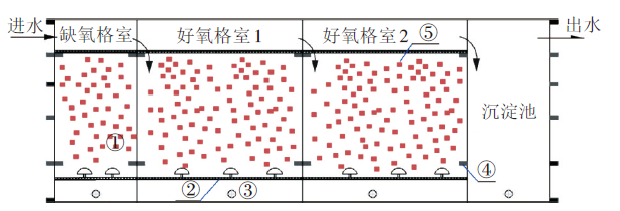
为提高低温处理效果,适应服务区污水处理低成本、低管养的实际需求,该服务区从生物载体、专属微生物强化、保温增温等方面对曝气生物滤池污水处理工艺进行优化改良,形成新型多介质生物滤池工艺[20]。在南侧服务区建设多介质生物滤池污水处理工程,设计处理能力为60m3/d,由缺氧格室、好氧格室1和好氧格室2组成,如图1 所示。缺氧格室采用微曝气,好氧格室采用常规曝气,滤池内部填充功能化网状载体。初期向系统投加高效微生物菌剂,运行过程中每2~3年排泥以维持系统稳定的污泥浓度。采用序批式进水和间歇曝气方式,稳定运行后曝气时间为10~15min/h。为提高低温期微生物活性,设置滤池加热保温措施,使温度始终维持在15℃以上,加温时间根据水温情况而定。该服务区设施于2013年10月开工建设,2013年11月建成完工,并于2014年3月启动,经35d的调试后,设施进入运营阶段,一直稳定运行至今。
2 试验材料与方法
2.1 采样及水质监测方法
在2014—2020年设施稳定运行的6年间,每年4个季度各采集1次水样,采样点固定在多介质生物滤池各格室末端、进水口处和出水口处,样品经过滤后现场测定COD, TN, NH3-N, NO2--N, NO3--N等指标浓度,测定过程中每个样品取3个平行样,每个平行样各测定1次,以保证数据的准确性。其中,COD采用重铬酸盐法测定,TN采用碱性过硫酸钾消解紫外分光光度法测定,NH3-N采用水杨酸分光光度法测定,NO2--N采用N-(1-萘基)-乙二胺光度法测定,NO3--N采用麝香草酚光度法测定。
2.2 宏基因组测序
系统内载体表面附着有高度复杂的微生物群落,在污水处理中起着至关重要的作用。为了解不同时期多介质生物滤池菌群结构变化及系统内去除氮素的关键菌属,分别于2020年1月12日和2020年9月30日从多介质生物滤池各格室的微生物载体中采集实验样本。采集的样品经低温运输(0℃ 以下)送往实验室后,提取DNA,然后保存在-20℃环境中。首先对各DNA样品分别提取80μL进行检测,使用琼脂糖凝胶电泳(Agarose Gel Electrophoresis, AGE)分析DNA的纯度和完整性,使用核酸蛋白荧光定量仪(Qubit Fluorometer)对DNA浓度进行精确定量,用Covaris超声波破碎仪将DNA随机打断成长度约为350bp的片段,再经末端修复、加A尾、加测序接头、纯化、PCR扩增等步骤后采用Illumina HiSeq高通量测序平台进行测序。采用宏基因组组装软件MEGAHIT(v1.0.6)对测序样本进行组装,使用diamond比对nr数据库,并结合megan6解析进行物种组成分析,从注释总结果拆分出古生菌、细菌、真核生物、真菌、病毒5大类以及界、门、纲、目、科、属、种7个分类水平信息。
3 结果与讨论
3.1 水质净化效果分析
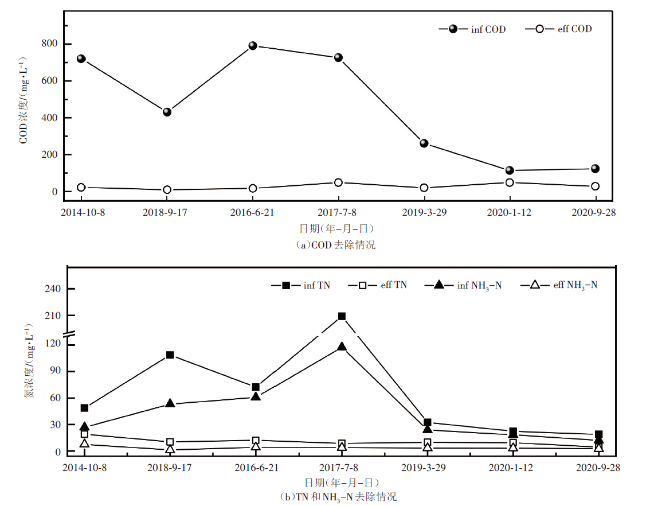
选取典型数据分析多介质生物滤池的处理效果。从2017年开始,系统进入稳定运行阶段,平均出水COD, TN和NH3-N分别达到27.72mg/L, 10.54mg/L和3.66mg/L。该多介质生物滤池对COD的去除效果如图2 (a)所示,尽管进水COD波动较大,但该工艺对COD去除效率一直较为稳定,出水COD均在50mg/L以下,达到《城市污水处理厂污染物排放标准》(GB/T 18918—2002)一级A标准,平均去除率达90.86%,表明该工艺具有较强的耐冲击能力。系统进出水TN及NH3-N去除情况如图2 (b)所示,由于服务区人流量变化较大,不同季节用水量存在差异,导致产生的污水量及进水水质波动较大,可以看出工艺运行初期(2014年)出水水质不稳定,出水TN达18.98mg/L,而后出水TN浓度呈逐年下降趋势,2020年9月系统的总氮去除率达76.69%,表明系统曝气量充足,硝化及反硝化菌活性良好。综上所述,该工艺可有效去除污水中的COD, TN, NH3-N,使出水水质稳定达标。
3.2 氮素去除途径分析
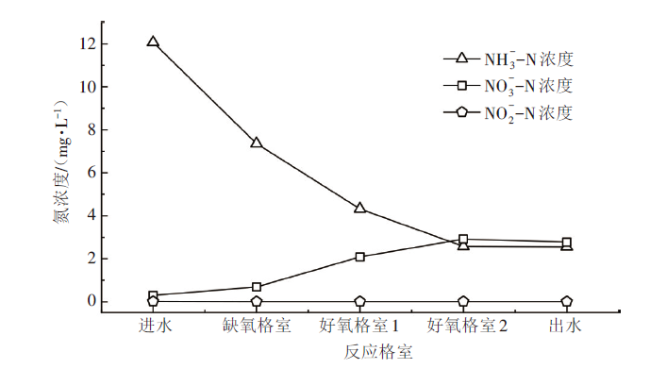
为了进一步分析多介质生物滤池工艺的氮素去除途径,以2020年9月28日滤池沿程氮素变化情况为例,测定其NH3-N, NO2--N及NO3--N浓度,如图3 所示。废水中主要污染物NH3-N首先进入系统缺氧格室,在微曝气环境中通过硝化作用部分被转化为NO3--N,而后经反硝化作用进一步还原为N2,使部分氮素从水中脱除,充足的基质NH3-N及微氧环境为该格室反硝化脱氮菌提供了较好的生存环境,也为厌氧氨氧化菌的富集提供了可能。相比于传统脱氮途径,厌氧氨氧化脱氮途径被认为是更加经济高效的脱氮方式[21]。接着,废水进入好氧格室,经正常曝气,NH3-N被进一步氧化,TN浓度大幅降低,使出水水质达标,出水NH3-N, NO2--N及NO3--N浓度分别为2.56mg/L, 0.01mg/L, 2.78mg/L。经氮素转化分析可知,系统共去除TN约14.41mg/L,去除NH3-N约9.51mg/L,全程基本无NO2--N剩余,缺氧格室、好氧格室1及好氧格室2对TN去除的贡献率分别为68.36%, 18.67%和13.95%,可见TN主要在缺氧格室被去除。值得注意的是,缺氧格室处于微曝气环境,而好氧格室1和好氧格室2处于正常曝气环境,但是NH3-N在缺氧格室中被消耗最多(降低了4.71mg/L),此时几乎未检测到NO2--N,若不考虑厌氧氨氧化作用,则认为缺氧格室中氮素是通过全程硝化(NH3-N→NO3--N)和全程反硝化(NO3--N→N2)去除的,即反硝化去除4.32mg/L的NO3--N。不过,由于缺氧格室在微曝气环境下NH3-N浓度的降低量较大,猜测可能存在厌氧氨氧化菌[22-23],即通过厌氧氨氧化过程(NH3-N+NO2--N→N2)消耗了部分NH3-N和NO2--N。因无法确定厌氧氨氧化菌的存在及其脱氮贡献率,需进一步开展系统菌群结构特性分析。
3.3 菌群特性分析
3.3.1 系统内菌群总体特性分析
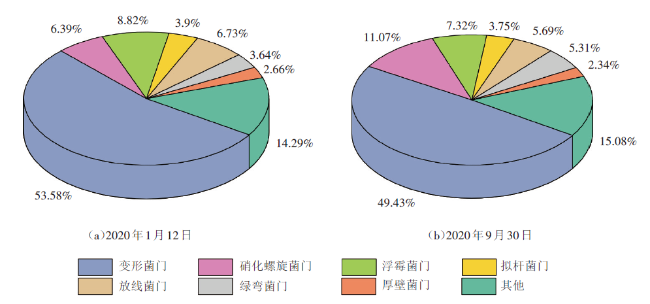
研究测定了秋冬两季多介质生物滤池在门水平上的菌群相对丰度(见图4 ),发现多介质生物滤池系统内主要菌门为变形菌门、硝化螺旋菌门、浮霉菌门、拟杆菌门、放线菌门、绿弯菌门和厚壁菌门等,与城镇污水处理系统优势菌门相近,可能由于服务区污水和城镇污水的主要成分接近。系统内变形菌门和绿弯菌门为具有反硝化功能的菌门[24-25],其中绿弯菌门为兼性厌氧菌,常在富集有厌氧氨氧化菌的系统中被发现[26];硝化螺旋菌门含有能够将NO2-氧化为NO3-的亚硝酸盐氧化菌[27];浮霉菌门为厌氧氨氧化菌相关菌门,主要由Candidatus Brocadia和Candidatus Kuenenia菌属组成[28],该菌门在缺氧环境中,以CO2为唯一碳源,NH3为电子供体,NO2-为电子受体,生成N2实现系统低能耗脱氮;拟杆菌门为厌氧菌,能够将复杂大分子有机物降解为简单小分子有机物,主要存在于低氧或缺氧环境中[29];放线菌门能够分解纤维素等复杂有机物[30];厚壁菌门具有硝化或反硝化功能[31]。正因为系统内存在大量硝化菌和反硝化菌,浮霉菌门可能有助于TN去除,故系统表观氮素处理效果很好。此外,拟杆菌门和放线菌门有利于降解系统内复杂有机物,因此系统对COD去除效果一直高效稳定。由于变形菌门、拟杆菌门、厚壁菌门均为耐低温菌[32-33],进一步从分子生物学角度解释了本系统在低温环境下处理效果好的原因。
3.3.2 系统各格室菌群特性分析
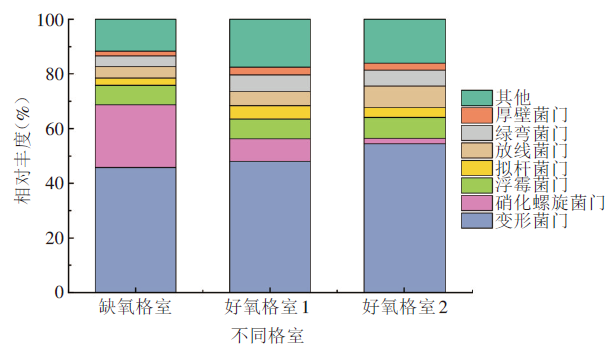
为进一步探究多介质生物滤池不同格室内菌群结构变化对系统脱氮的影响,选取2020年9月30日的菌门相对丰度占比情况进行分析,如图5 所示。缺氧格室、好氧格室1及好氧格室2中具有反硝化功能的变形菌门相对丰度分别为45.74%, 48.10%和54.45%,即好氧格室2的反硝化相关菌门相对丰度最大。而图3 所示的沿程数据显示好氧格室2基本没有反硝化作用,这可能是由于该格室曝气量过大,导致反硝化活性受到抑制,因此应适当降低曝气量以提高反硝化活性。此外,图5 所示的硝化螺旋菌门在缺氧格室、好氧格室1及好氧格室2中相对丰度逐渐降低,分别为23.02%, 8.16%和2.02%,可能是由于缺氧格室进水NH3-N浓度较高,在该格室经硝化作用积累的NO2--N浓度较高,为硝化螺旋菌门提供了更多的NO2--N基质,从而富集了硝化螺旋菌门。值得注意的是,在菌属统计中发现系统存在自富集厌氧氨氧化菌属Candidatus Brocadia,其相对丰度均值为0.08%,其中在缺氧格室的相对丰度为0.06%,比以往研究的Anammox菌丰度占比要高,如Wang等[34]通过qPCR测定系统絮凝污泥中Anammox菌的相对丰度,发现其小于0.003%;Guo等[35]通过宏基因组测序发现Anammox菌的相对丰度小于0.01%,可能是由于本系统内长期同时存在NH3和NO2-基质,为厌氧氨氧化菌提供了适宜的底物环境,使厌氧氨氧化菌不断富集,结合工艺沿程数据分析可知,TN在缺氧格室中共去除9.85mg/L,即对TN去除的贡献率为68.36%,说明厌氧氨氧化菌对系统TN的去除有一定的贡献。


3.4 工艺优化建议
针对上述微观菌群特性研究,从设施的处理效果和运行成本的宏观角度,提出工艺优化建议:①好氧格室2的进水NH3-N浓度较低,无需提供过大的曝气量,否则会造成反硝化菌活性降低与曝气能耗成本增加,因此可适当降低好氧格室2的曝气量,并辅以投加有机碳源的措施,以提高工艺的脱氮效果;②增设污泥回流管,污泥由沉淀池底部以一定比例流至缺氧格室首端,增大了缺氧格室污泥浓度,出水NH3-N可进一步得到降解,通过强化反硝化及厌氧氨氧化活性,充分发挥缺氧格室脱氮作用,进一步提高服务区污水特征污染物氮素的去除效果。
4 结论
本文以吉林省某服务区多介质生物滤池污水处理工程为研究对象,通过6年不同季节的长期跟踪水质处理效果监测,发现该工艺平均出水COD, TN和NH3-N分别为27.72mg/L, 10.54mg/L和3.66mg/L,达到了《城镇污水处理厂污染物排放标准》(GB 18918—2002)一级A标准,处理出水效果良好。通过分析处理系统内微生物群落分布情况,研究得出系统内沿程氮素去除途径,并确定了对TN去除贡献率(68.36%)最大的为缺氧区,该区域自富集了0.06%的厌氧氨氧化菌属Candidatus Brocadia,可同时消耗NH3-N和NO2--N基质,促进TN去除;研究确定了促进系统脱氮的关键菌,系统反硝化耐寒关键菌门为变形菌门,相对丰度为49.43%,亚硝酸盐氧化关键菌属为硝化螺菌属,相对丰度为32.60%,耐低温菌为变形菌门、拟杆菌门、厚壁菌门。研究结果可为多介质生物滤池工艺优化及耐低温菌属筛选提供依据,从而缩短处理系统调试时间,提高系统抗冲击能力。