
0 引言
我国城市交通碳排放具有规模大、增速快、减排难等主要特征,是影响交通行业实现“碳达峰、碳中和”目标的关键领域。近年来,随着城镇化和机动化水平的提升,城市交通取得了快速发展,极大方便了市民出行,但日益严重的城市交叉口拥堵影响了城市交通的运行效率,同时加剧了城市交通的碳排放增长[1]。智能交通技术的快速发展为解决交叉口拥堵问题及实现城市交通深度碳减排提供了更多可能性。2021年10月,中共中央、国务院印发《关于完整准确全面贯彻新发展理念做好碳达峰碳中和工作的意见》,明确提出加大城市交通拥堵治理力度、推广智能交通技术等重点任务[2]。因此,通过运用智能交通技术,加强开展交叉口缓堵和减排协同治理,成为近期重点研究方向之一。智能化信号控制系统(以下简称“智能信控系统”)作为智能交通技术的其中之一,其推广应用对城市交叉口拥堵治理及助力实现碳减排目标具有重要作用。
国内外学者围绕信号控制系统优化促进道路交叉口拥堵治理和城市交通碳排放评估方面已开展了大量研究。Matthew等[3]利用车辆运行检测技术、车辆活动数据库及基于车辆类型设计的排放模型,对缓堵策略、速度管理策略等在碳减排方面的作用进行了评估。Li等[4]基于电子收费系统和车联网数据,提出一种动态信控优化模型,有效减少了交叉口车辆等待时长、停车次数,同时实现了碳减排效益。苏春敏等[5]运用Synchro软件进行交通信号配时优化,分析得出这种交叉口信号配时优化可使早、晚高峰碳排放量分别降低21.47%和18.06%。李宾等[6]根据城市道路交叉口交通实况调查数据,提出了由于交通拥堵造成的碳排放效应计算方法,计算出交通拥堵时段交叉口交通流的碳排放量。唐旭南[7]结合微观交通仿真VISSIM模型,建立基于机动车比功率(Vehicle Specific Power, VSP)分布的污染物排放模型,并搭建了机动车尾气排放测算平台,用于计算机动车在城市道路交叉口的环境排放。姚荣涵等[8]以相位有效绿灯时间为决策变量,构建了以机动车排放总量最小化为目标函数的干线交叉口群时空资源信号优化模型,并通过VISSIM模型标定红绿灯期间的排放因子,计算获得优化配时方案。
总体而言,现有研究主要围绕传统单一或连续交叉口信号配时方案建立碳排放评估模型,但随着交通信号控制技术趋势由“点控”“线控”转向“面控”,即由单一交叉口控制、干线协调控制转向多点、联测、联动控制的区域智能控制,相应的碳减排效果评估分析研究还较少。因此,利用智能信控系统的交通流、交叉口车辆排队等数据开展碳减排效益评估方法研究,对全面评估智能信控系统应用带来的减排效益具有重要的现实意义。
为量化智能信控系统的碳减排效益,本文将通过分析交叉口的交通流特征和智能信控系统的技术原理,提出智能信控系统的碳减排原理,并据此提出“自下而上”的智能信控系统碳减排效益评估方法,通过对各交叉口进口不同车道的分类测算,提高碳减排效益评估的精度。
1 智能信控系统的碳减排原理
交通信号控制系统被用于调节交叉口信号灯相位,针对不同方向的交通流给予相应的放行时间,使交通流更加顺畅。该系统可分为定时控制和感应式控制,其中定时控制系统主要基于人工检测和设置配时参数,不能根据交通流量自适应地动态调节信号时长,可能造成车辆延误时间长及不必要的怠速等待等;感应式控制根据不同的车流状态,应用不同的控制模式,随着自动化检测技术和人工智能技术的发展,已能实现对交叉口交通流实时、多点、联测、联动控制,是近期的重要发展方向[9]。
随着智能技术的快速发展,智能信控系统借助自动化检测设备可实现全天候交通流观测,运用交通工程学、应用数学、自动控制以及系统工程学等理论,自动生成信号配时方案,合理分配路权,保障车辆有序、高效地通行。智能信控系统能根据实际交通流状态实行动态调节,即根据实际交通状况、拥堵程度自动调节红绿灯时长,实现交通信号控制的智能化升级,使车辆行驶更加畅通高效,减少交叉口交通拥堵[10]。
基于上述技术原理,确定智能信控系统的碳减排原理为:智能信控系统可实现城市交叉口实时、多点、联测、联动控制,促进人、车、道路、交叉口的和谐、密切配合,使更多车辆在行驶至交叉口时能匀速通过,显著减少车辆在交叉口的停驶等待、加速行驶和低速行驶(车速≤10 km/h)等高碳排放状态,在提升交叉口车辆通行能力和通行效率的同时,产生碳减排效益。
2 智能信控系统的碳减排核算方法
为核算因智能信控系统的应用产生的碳减排量,首先要基于系统应用后产生的影响范围来确定核算范围,然后计算此范围内因信号灯相位调节而新增的交通流量,最后基于智能信控系统的碳减排原理,提出碳减排效益的评估方法。
(1)确定交叉口核算范围
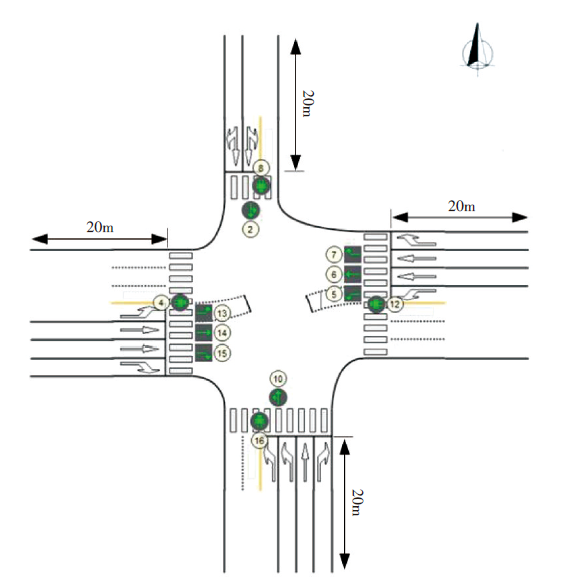
交叉口在各个方向上的碳排放核算范围以行驶车辆从到达交叉口之前的减速点(如:交叉口前20m)开始,到车辆通过交叉口后加速至平稳行驶的行驶点(如:通过交叉口后继续行驶20m)结束,而各个方向的范围叠加即为交叉口碳排放量核算范围,见图1 。
(2)计算实际交通流增量
式(1)中: 为智能信控系统应用前后交叉口第i车道的交通流单日变化量(辆/d); 为应用智能信控系统后第 车道第t小时的交通流量(辆/h); 为应用智能信控系统前第i车道第t小时的交通流量(辆/h);T是智能信控系统的单日运行时间(h)。
(3)确定碳排放强度
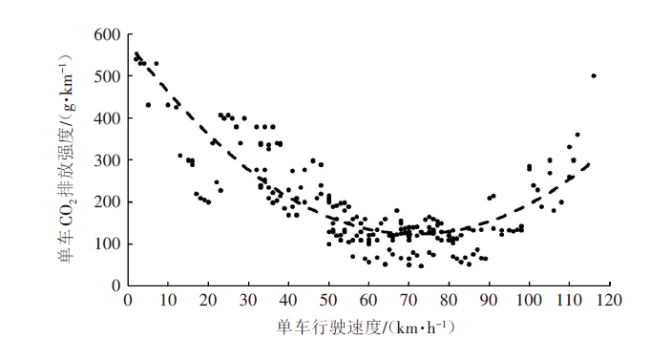
本文以小汽车为重点研究对象,公交车、物流车辆等其他车型暂不考虑。基于现有的城市交通碳排放因子,利用排放测试设备开展车辆行驶工况补充测试,考虑车辆的速度工况、道路类型等相关因素,计算发动机功率、速度及能耗与碳排放的相互关系,建立各种车型对应的发动机图谱,最后得出典型工况对应的排放强度。考虑到缺少较详细的车型分类数据,本文对车型因素作简化处理,以1.6L排量小汽车为代表车型,绘制该类车型的单车车速与碳排放强度关系曲线,见图2 。
(4)计算碳减排量
第一步:计算系统应用后的单日碳排放量。
从宏观层面看,在应用智能信控系统后,新增交通流量的运行特征是当车辆行驶到交叉口时没有发生停车等待,而是直接匀速通过,对应的单日碳排放量计算公式为:
式(2)中: 为智能信控系统应用后的单日碳排放量(折算为CO2排放量,下同)(t); i为进口车道 新增交通流量的行驶距离(km); 为匀速行驶车辆的碳排放强度(g/km);I为交叉口所有进口道i的集合; 含义同前。
第二步:计算系统应用前的单日碳排放量。
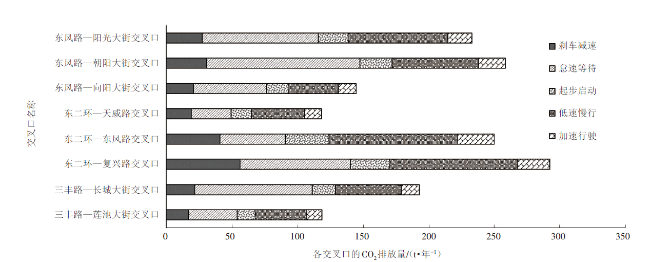
假设在同等交通流量条件下,当车辆行驶至交叉口时正好为红色相位,需停车等待后再启动行驶通过交叉口,对应的单日碳排放量按式(3)计算。车辆运行状况可分为制动减速、怠速等待、起步启动、低速慢行和加速通行5个阶段,各阶段的单日碳排放量计算方法有所不同,其中制动减速、起步启动、低速慢行和加速通行4个阶段的单日碳排放量按式(4)计算,怠速等待阶段的单日碳排放量按式(5)计算。
式(3)~式(5)中: 为系统应用前的单日碳排放量(t); 为制动减速、起步启动、低速慢行和加速通行4个阶段的单日碳排放量(t); 为制动减速阶段的单日碳排放量(t); 为起步启动阶段的单日碳排放量(t); 为低速慢行阶段的单日碳排放量(t); 为加速通行阶段的单日碳排放量(t);j为车辆在交叉口范围的各行驶阶段,即制动减速阶段、起步启动阶段、低速慢行阶段和加速通行阶段;J为各行驶阶段j的集合; 为怠速等待阶段的单日碳排放量(t); 为车辆在不同行驶阶段的行驶距离; 为各阶段车辆的碳排放强度(g/km); 为第i车道累计怠速等待时间(s),具体基于各交叉路口相位图中红灯时长、绿灯时长及模型仿真来确定; 为怠速阶段车辆的碳排放强度(g/s);其他变量含义同前。
第三步:计算全年碳减排量。
通过前后对比,按式(6)计算全年实现的碳减排量:
式(6)中: 为系统应用后的全年碳减排量(t);其他变量含义同前。
3 案例分析
3.1 案例介绍
为缓解交通拥堵,保定市开展了智能交通建设项目,其中智能信控子系统已建成并投入运行。在该项目中分两期共安装完成176个交叉口智能化信号控制设备设施,实现了基于人工智能(Artificial Intelligence, AI)的交通状态可视化监测、智能优化交通信号配时等,经评估,取得了如下主要效果:
(1)实现176个路口自适应控制,缩短了车辆无效等待时间,最大限度减少了各方向的无效等待,使绿灯放行时间与交通流量相匹配。
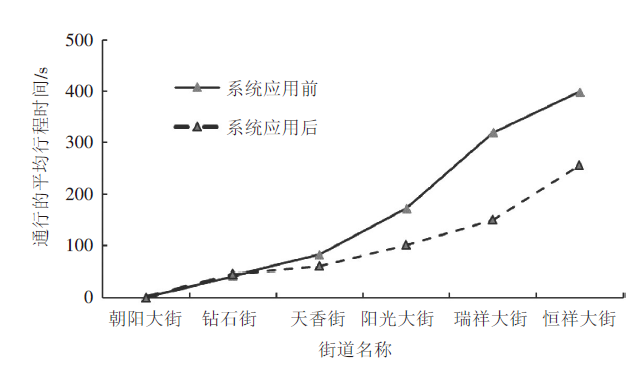
(2)实现25个子区绿波通行效果,行驶车辆可连续通过多个交叉口。协调东风路、朝阳大街、七一路及恒祥大街等25个子区各交叉路口的绿灯启亮时差,保障车辆连续通过多个交叉口,减少车辆停车次数,缩短行程时间,提高行驶速度。七一路(朝阳大街—恒祥大街)子区西向东行程时间平均缩短1~2min,车速平均提高约11km/h,停车次数平均减少2次,见图3 。
3.2 碳减排效益评估
本研究选取东风路—阳光大街交叉口、东风路—朝阳大街交叉口、东风路—向阳大街交叉口、东二环—天威路交叉口、东二环—东风路交叉口、东二环—复兴路交叉口、三丰路—长城大街交叉口、三丰路—莲池大街交叉口8个交叉路口,收集了一周的视频数据,分析其交通流量变化情况。因缺少具体的车型分类数据,因此仍以1.6L排量的小汽车作为典型车型。
(1)计算新增的交通流量
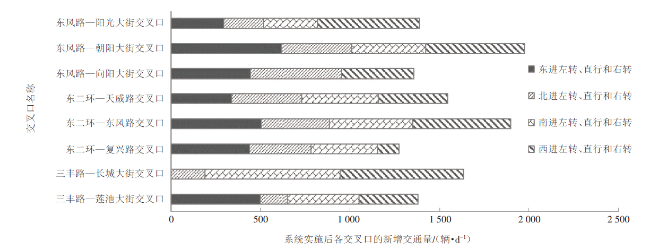
收集各交叉口的交通流量、车辆排队、交叉口相位图等相关数据,利用VISSIM中的交通仿真模型综合分析交叉口的通行能力,计算得出每个交叉口各方向(东进左转、东进直行、东进右转、北进左转、北进直行、北进右转、南进左转、南进直行、南进右转、西进左转、西进直行、西进右转)新增交通流量。通过汇总,东风路—阳光大街交叉口、东风路—朝阳大街交叉口、东风路—向阳大街交叉口、东二环—天威路交叉口、东二环—东风路交叉口、东二环—复兴路交叉口、三丰路—长城大街交叉口、三丰路—莲池大街交叉口的平均每日新增交通流量分别为1 379辆/d, 1 976辆/d, 1 356辆/d, 1 547辆/d, 1 899辆/d, 1 273辆/d, 1 634辆/d, 1 388辆/d,见图4 。
(2)计算碳排放量
首先,按照式(2),计算智能信控系统应用后, 东风路—阳光大街交叉口、东风路—朝阳大街交叉口、东风路—向阳大街交叉口、东二环—天威路交叉口、东二环—东风路交叉口、东二环—复兴路交叉口、三丰路—长城大街交叉口、三丰路—莲池大街交叉口的碳排放量分别为67.0t, 59.2t, 33.2t, 36.9t, 80.2t, 69.8t, 43.4t, 33.2t。
接着,按照式(3)~式(5),基于百度地图、交叉路口相位图等确定交叉路口各方向的行驶距离、红灯时长、绿灯时长等,以确定核算范围内的行驶距离、怠速等待时间等,计算东风路—阳光大街交叉口、东风路—朝阳大街交叉口等8个交叉口在同等交通流量下,智能信控系统应用前制动减速、怠速等待、起步启动、低速慢行及加速通行5个阶段的碳排放量分别为232.8t, 258.4t, 144.8t, 118.0t, 250.0t, 292.3t, 192.7t, 118.5t,见图5 。


最后,根据式(6),计算得出智能信控系统应用后东风路—阳光大街交叉口、东风路—朝阳大街交叉口、东风路—向阳大街交叉口、东二环—天威路交叉口、东二环—东风路交叉口、东二环—复兴路交叉口、三丰路—长城大街交叉口、三丰路—莲池大街交叉口的年碳减排量分别为165.8t/年, 199.2t/年, 111.6t/年, 81.1t/年, 169.8t/年, 222.5t/年, 149.3t/年, 85.3t/年,平均每个交叉口的碳减排量为148t/年,碳减排效益显著。
4 结语
本研究基于城市交叉口交通流理论及车辆运行特征,综合分析智能信控系统特点、城市交通碳排放评估方法、排放强度测试技术等,提出了宏观层面的智能信控系统碳减排效益评估方法,并选取保定市智能交通项目信号配时和交通流数据进行了实证分析,验证了所提方法的可行性和有效性,进一步丰富了城市交通碳排放核算方法体系,也为后续将智能信控系统碳减排效益评估方法纳入我国国家核证自愿减排量(Chinese Certified Emission Reduction, CCER)和城市交通碳交易体系提出了探索性思路。由于城市路网交通流具有随机波动性,路网路段和交叉口的交通流在空间和时间上存在较强的相互作用,后续研究可对方法进行优化,基于动态交通流模型关联相邻信号交叉口的交通流量,进一步提升智能信控系统碳减排效益评估方法的适用性和评估精度。